
Can you use WhatsApp and bulk SMS for a political campaign in India in 2026? Yes, but with rules. Bulk SMS is legal if you send it from a TRAI DLT-registered sender, get every message pre-certified by the Election Commission’s Media Certification and Monitoring Committee (MCMC), add the cost to your election expenses, and stop all bulk messages 48 hours before polling ends. WhatsApp works differently. Its official Business Platform bans parties, candidates and campaign agencies. So campaigns use WhatsApp through volunteers, groups, Channels and opt-in communities, not through bulk API blasts.
That one paragraph is the whole game. The rest of this guide shows you how to do it step by step.
Why this playbook matters now
Elections in India are won in phones as much as on streets. A voter may skip a rally. They rarely skip a message from someone they know.
But the rules changed a lot in the last two years. TRAI tightened its spam rules in February 2025. The Digital Personal Data Protection (DPDP) Rules were notified in November 2025. The Election Commission issued a fresh order on political ads in March 2026. And WhatsApp updated its business policy in September 2026, keeping its ban on political use of the Business Platform.
Many campaigns still work the old way. They buy phone lists, use cloned WhatsApp apps and blast messages at midnight. That now leads to blocked numbers, banned accounts, notices from the returning officer and angry voters.
This playbook is for candidates, party IT cells, campaign managers and agencies. It covers:
- What each channel is good at
- The exact laws and platform rules for 2026
- A step-by-step plan from 90 days out to counting day
- Message examples, costs, metrics and common mistakes
- Answers to the questions people search most
We run political election campaign services at SpaceEdge Technology and have handled DLT-compliant messaging since 2008. Everything below is based on current official rules, linked at the end, plus what we see work on the ground.
Why WhatsApp and bulk SMS still decide Indian elections
Two simple facts explain why every serious campaign uses both channels.
First, WhatsApp is everywhere. Researchers estimate it has about 500 million users in India, and it has become a key election tool for parties and a daily place where citizens talk politics. Family groups, society groups and caste or village groups all live there.
Second, SMS reaches every phone. A farmer with a basic feature phone gets an SMS. So does a senior citizen who never installed WhatsApp. SMS needs no internet, no app and no data pack.
What each channel does best
| Channel | Best for | Reach | Main limit |
|---|---|---|---|
| Bulk SMS | Short, official updates to every voter on your list | Every mobile phone, including feature phones | 160 characters; needs DLT and MCMC approval |
| WhatsApp (volunteer and group use) | Videos, posters, local news, two-way talk | Smartphone users who trust the sender | No legal bulk API for campaigns; forward limits |
| Voice call broadcast | Candidate’s own voice, low-literacy voters | Every phone | Feels intrusive if overused |
| Missed call number | Building an opt-in supporter list | Anyone who can dial | Needs promotion through other media |
| Social media | Wide awareness, younger voters | Smartphone users | Paid ads need pre-certification too |
SMS is your loudspeaker, WhatsApp is your living room
Think of bulk SMS as the official loudspeaker. It carries the candidate’s name, the polling date, the rally venue and the booth details. Short, clear and sent to everyone at once.
Think of WhatsApp as the living room. A booth volunteer shares a 30-second video in the colony group. An uncle forwards it to his cousins. People ask questions and get answers from someone they know. That trust is something SMS can’t buy.
Winning campaigns use both together. SMS tells people what and when. WhatsApp helps them feel why.
Where voice calls and missed calls fit
A recorded message in the candidate’s own voice works well in rural seats and with older voters. Pair SMS with voice call broadcasts for key moments such as the manifesto launch or the final appeal. Voice broadcasts follow the same pre-certification and silence-period rules as SMS.
A missed call number is the easiest way to build a consented list. Print it on posters and say it at rallies: “Give a missed call to join our updates.” Each caller has chosen to hear from you, which matters a lot under the DPDP Act.
For reach beyond your list, add social media marketing. Just remember that paid social ads also need MCMC approval.
The 2026 rulebook: what is legal and what is not
Seven sets of rules apply to political messaging in India. Break any one and you risk a notice, a blocked sender ID or a banned account. Here they are in plain words.
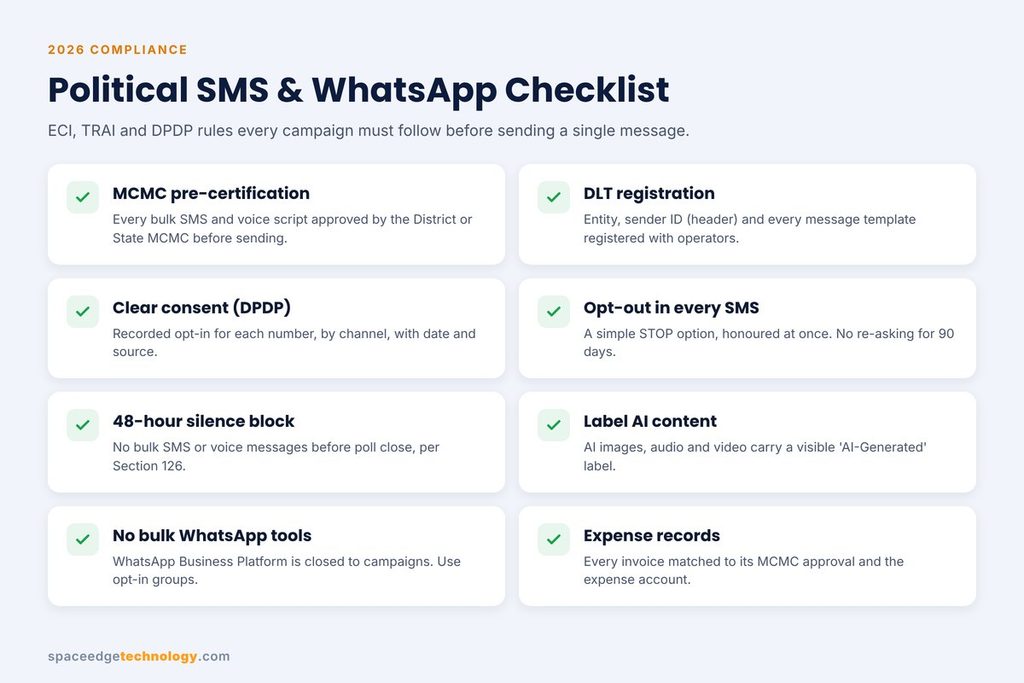
| Rule | Who sets it | What it means for you |
|---|---|---|
| MCMC pre-certification | Election Commission of India | Every bulk SMS, voice message and social media ad needs approval before it goes out |
| 48-hour silence period | Representation of the People Act, Section 126; ECI | No bulk SMS or voice messages in the 48 hours before polling ends |
| Election expenditure | ECI | Messaging costs count toward the candidate’s spending limit |
| DLT registration and consent | TRAI (TCCCPR) | Every commercial SMS must use a registered sender ID and template |
| Personal data consent | DPDP Act 2023 and DPDP Rules 2025 | You need clear, specific consent to use someone’s phone number |
| Platform policy | WhatsApp (Meta) | The WhatsApp Business Platform cannot be used by parties, candidates or campaign agencies |
| AI content labels | ECI advisory | AI-made images, audio or video must carry a visible label |
1. ECI pre-certification through MCMC
In March 2026, the Election Commission issued an order covering political ads on electronic and digital media. Parties, candidates and even individuals or groups must get approval from the MCMC before publishing. The order names bulk SMS and voice messages directly, along with TV, radio, e-papers and social media .
How it works:
- Candidates and individuals apply to the District MCMC.
- Parties headquartered in a state or UT apply to the State MCMC.
- If the MCMC rejects your message, you can appeal to a state committee headed by the Chief Electoral Officer.
In practice, districts usually ask for the exact script, a self-signed copy and the audio or video file on a set form, submitted at the District Public Relations Officer’s office. Apply early. Committees get flooded in the last two weeks.
Tip: get a small library of messages approved in one go. Rally reminders, manifesto points, polling day appeal and thank-you notes. Then you only fill in dates and venues that were part of the approved script.
2. The 48-hour silence period
Section 126 of the Representation of the People Act creates a quiet window. The ECI has made it clear that bulk SMS and voice messages are banned in any polling area during the 48 hours ending with the close of poll.
In a multi-phase election, each area has its own silence window. A state-wide campaign must turn off sending for each constituency on its own schedule. Set this up in your SMS panel as a hard block, not a reminder.
3. Expenditure reporting
The cost of political ads, including bulk messages, is counted as election expenditure. Parties must also file a statement of internet and social media campaign spending within 75 days of the assembly election ending. Keep every invoice from your SMS provider and match it to the MCMC approval number.
4. TRAI DLT rules for SMS
All commercial SMS in India must pass through the DLT (Distributed Ledger Technology) system run by telecom operators. TRAI tightened these rules in February 2025 (TRAI press release). Key points for campaigns:
- Register your party or candidate as a principal entity on DLT.
- Register your sender ID (header), such as a short name for the candidate.
- Register each message template before sending.
- Promotional messages must carry an easy opt-out option.
- Headers now show a suffix such as -P for promotional or -G for government, so people can see the message type.
- If someone opts out, you cannot ask them for consent again for 90 days.
- Promotional calls must come from the 140 number series (FoneArena summary).
Promotional SMS also respects DND (Do Not Disturb) choices unless the person has given you explicit consent. That is why a consented list beats a bought list every time.
5. DPDP Act and Rules: consent is now the law
The Government notified the DPDP Rules on November 14, 2025. They give full effect to the DPDP Act 2023 and roll out in phases over 18 months. Consent-manager registration starts in November 2026. The main consent, breach and children’s data duties apply from May 2027 (Anantam IAS summary).
What this means for a campaign:
- Consent must be clear, specific and given freely. A buried line in a form is not enough.
- People can withdraw consent at any time, and you must stop.
- Consent given for one purpose cannot be reused for another. A phone number shared for a ration-card camp is not consent for campaign SMS.
- Bundled consent is risky. Ask separately for SMS, WhatsApp and calls.
Even where some duties start in 2027, build your system to this standard now. Lists you collect in 2026 will be used in 2027 and beyond.
6. WhatsApp’s political use policy
This is where most campaigns get it wrong. WhatsApp’s Business Messaging Policy, last updated September 23, 2026, says three things clearly (WhatsApp Business Policy):
- Government entities may use the WhatsApp Business Platform through an approved solution provider.
- Political parties, politicians, candidates and campaigns may not use the Business Platform.
- Companies that offer political campaigning or campaign strategy services may not use it either.
The policy also says WhatsApp can limit or remove accounts that message people at scale in an unauthorised way. Back in 2019, WhatsApp warned Indian parties that the app is not a broadcast platform and that it would ban accounts using automated bulk tools .
So what is allowed? Normal people using normal WhatsApp. A volunteer can run a group of neighbours who chose to join. A candidate can post updates to a WhatsApp Channel that people follow. Supporters can forward content they like. What is not allowed is buying “bulk WhatsApp” software, cloned apps or API access to blast voters.
The Election Commission has also stepped in when official channels were used for political messages. During the 2024 Lok Sabha election, it told the IT ministry to stop sending “Viksit Bharat” WhatsApp messages after complaints.
7. Labelling AI-made content
In October 2025, the ECI told parties that any AI-made or altered image, video or audio used in campaigns must carry a clear label such as “AI-Generated” or “Synthetic Content.” The label must cover at least 10% of the visible area, or the first 10% of an audio clip. Parties must also keep records of who made each piece and when (exchange4media).
If you use an AI voice clone of the candidate for a voice broadcast, label it. If you share an AI poster on WhatsApp, label it. Deepfakes of rivals are off limits entirely.
The step-by-step playbook: 90 days to counting day
A good messaging campaign is built, not blasted. Follow these steps in order.
Step 1: Set your goal for each channel (90 days out)
Start with three numbers:
- How many voters are on the roll in your seat?
- How many of them do you already have phone numbers for, with consent?
- How many do you want to reach at least five times before polling day?
Then give each channel one clear job. For example: SMS for official updates to every consented voter, WhatsApp for booth volunteers and supporter groups, voice calls for the final appeal, and social media for reach among first-time voters.
Step 2: Build a clean, consented contact list (90 to 60 days out)
Your list is your biggest asset. It is also your biggest legal risk. Build it the right way.
Good ways to collect numbers:
- A missed call number on posters, banners, autos and newspaper ads
- A simple opt-in page on your campaign website with a clear checkbox for SMS and a separate one for WhatsApp
- Sign-up sheets at rallies and door-to-door visits, where people tick what they agree to
- A QR code that opens a WhatsApp chat with a volunteer helpline
- Party membership drives where consent for messages is asked clearly
Ways to avoid:
- Buying “voter data” or phone lists from brokers
- Scraping numbers from WhatsApp groups
- Reusing numbers collected for government schemes or welfare camps
- Adding people to groups without asking
For each contact, store the name, phone number, booth or ward, the date of consent, the channel they agreed to and how they gave it. This record is your proof if anyone complains.
Step 3: Register on DLT and pick a provider (75 to 60 days out)
Choose an SMS provider with real political experience. Ask them:
- Will you help with DLT entity, header and template registration?
- Can your panel block sends by constituency during the silence period?
- Do you give delivery reports by booth or area?
- Can you send in Hindi and regional languages (Unicode)?
- Do you offer voice broadcasts and missed call numbers in the same panel?
- Will you provide GST invoices that match MCMC approval numbers?
SpaceEdge Technology offers promotional bulk SMS with DLT support, plus voice and missed call tools, so the whole stack sits in one dashboard.
Keep your sender ID short and easy to recognise. Voters should know who sent the message before they open it.
Step 4: Write and pre-certify your message library (60 to 45 days out)
Write 15 to 25 messages covering the whole campaign. Then submit them to the MCMC together, along with your DLT templates.
Good political SMS follow a simple pattern:
- Who is speaking (candidate name and party)
- One clear point or ask
- When and where, if there is an event
- A short link or number for more
- The opt-out line
Keep each message under 160 characters in English, or around 70 in Hindi and other Unicode languages, to avoid paying for two SMS.
Avoid anything that could break the Model Code of Conduct: appeals based on religion or caste, personal attacks on rivals’ private lives, unverified claims or promises of gifts. The MCMC will reject these, and they can lead to complaints.
Step 5: Set up WhatsApp the right way (60 days out)
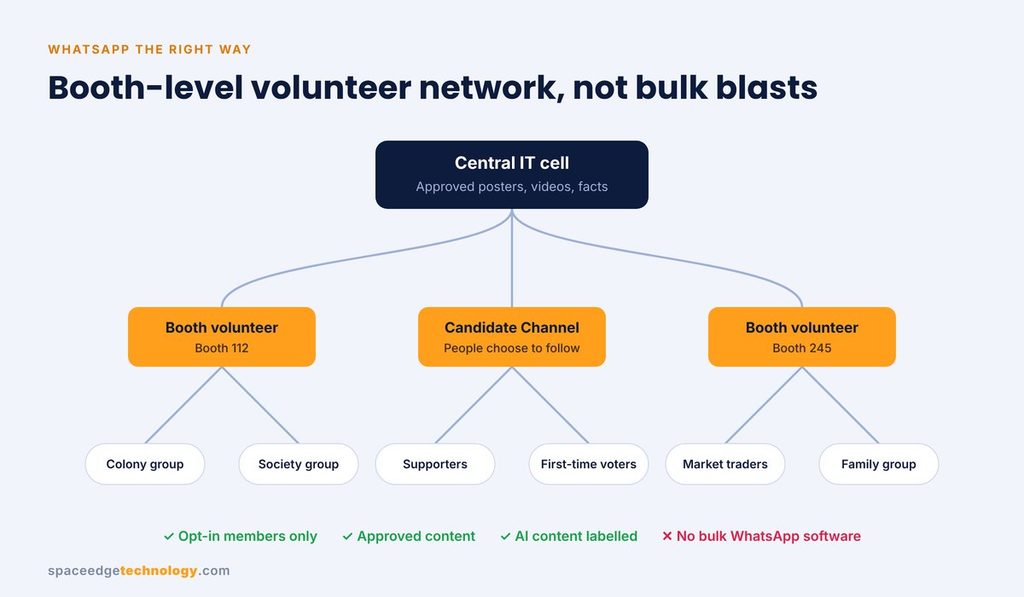
Since the Business Platform is closed to campaigns, build WhatsApp around people, not software.
Booth-level volunteer groups. Pick one or two trusted volunteers per booth. Each runs a small group of neighbours who chose to join. They share approved content from the central team and answer local questions.
A WhatsApp Channel for the candidate. Channels are one-way updates that people choose to follow. Promote the Channel link through SMS, posters and social media.
A central content group. The IT cell posts approved posters, videos and talking points here every morning. Volunteers pick what fits their area and share it.
Clear volunteer rules. Write a one-page guide: never add people without asking, never forward unverified news, label all AI content, stop posting in the silence period, and remove anyone who asks to leave.
Our WhatsApp marketing team can help design community content and volunteer playbooks that stay inside WhatsApp’s rules.
Step 6: Plan your message calendar (45 days out)
Spread messages across the campaign. Too many SMS feel like spam. Too few and voters forget you.
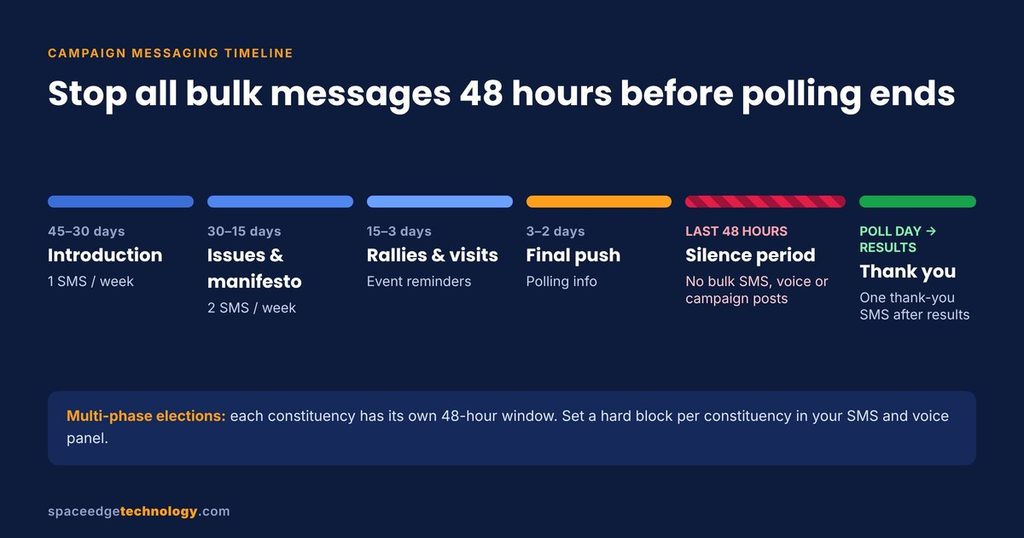
| Phase | Timing | SMS | Voice | |
|---|---|---|---|---|
| Introduction | 45 to 30 days before poll | 1 per week | Daily content to volunteer groups | None |
| Issues and manifesto | 30 to 15 days | 2 per week | Videos, local issue posts | 1 manifesto call |
| Rallies and visits | 15 to 3 days | Event reminders by area | Live updates, photos | 1 rally invite |
| Final push | 3 to 2 days | Polling date and booth info | Get-out-the-vote plans | Final appeal |
| Silence period | Last 48 hours | No bulk SMS | No campaign posts | No broadcasts |
| After results | Counting day onward | Thank-you message | Thank volunteers | Optional |
Send between 10 AM and 8 PM. Morning sends around 10 to 11 AM and evening sends around 6 to 7 PM usually get the best attention.
Step 7: Segment and personalise (ongoing)
One message for everyone is a waste. Split your list by:
- Booth or ward, so rally reminders only go to people nearby
- Language, so people read messages in the language they think in
- Voter type, such as first-time voters, senior citizens, women’s self-help groups or farmers, based on what people told you when they signed up
- Engagement, so people who clicked or replied get more detail
Do not segment by religion or caste. It is risky under the Model Code of Conduct and can attract legal trouble.
Step 8: Open a two-way channel (ongoing)
Voters want to be heard, not just told. Give them a way to reply.
- A long code SMS number lets people text back a keyword such as their ward name or a complaint.
- A WhatsApp helpline run by real volunteers can answer questions about booth location, voter ID and local issues.
- A missed call number for “I want to volunteer” helps you grow your team.
Every reply is a signal. Share common questions with the candidate’s team every evening.
Step 9: Lock the silence period (3 days out)
Two days before each phase, the central team should:
- Switch on the constituency block in the SMS and voice panel
- Post a message in every volunteer group: stop all campaign posts now
- Cancel any scheduled sends that fall inside the window
- Keep only non-campaign service messages, like volunteer duty timings sent one-to-one
Step 10: Thank, learn and keep the list warm (after results)
Win or lose, send a thank-you SMS after the result. It is polite and keeps your sender ID trusted.
Then review your numbers: delivery, clicks, replies, opt-outs and turnout in booths where you messaged most. Keep your consented list clean and updated for the next local body or by-election. People who opted out stay out.
Sample political SMS messages you can adapt
These are examples to shape your own scripts. Each one still needs DLT template registration and MCMC approval before you send it. Replace the names in brackets.
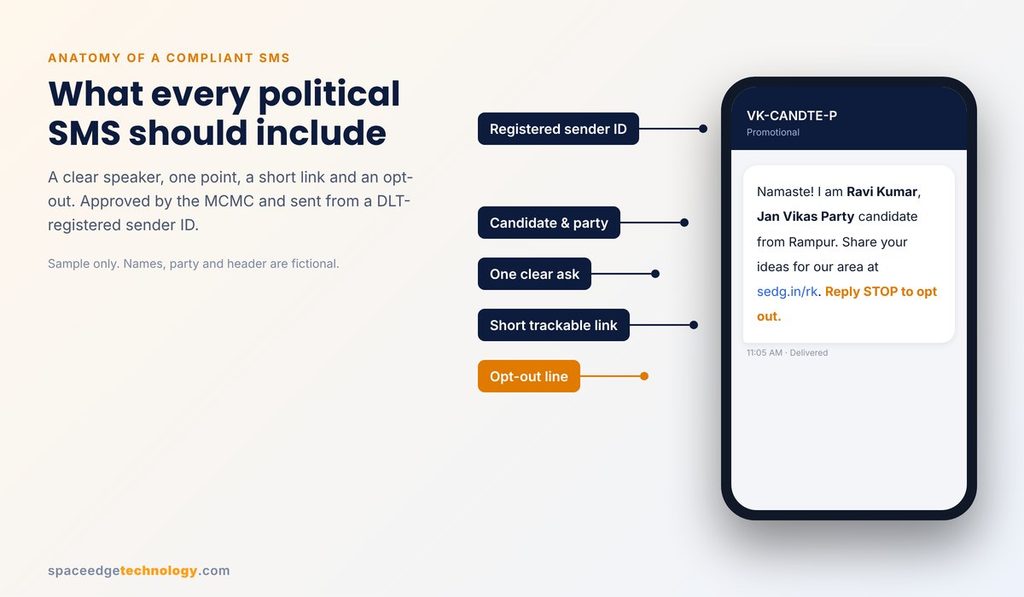
Introduction
Namaste! I am [Name], [Party] candidate from [Seat]. I want to hear your ideas for our area. Share them at [short link]. Reply STOP to opt out. -[Header]
Rally reminder
Join [Name] at a public meeting on [date], [time] at [venue], [ward]. Your voice matters. Reply STOP to opt out. -[Header]
Manifesto point
[Name] promises [one specific promise] for [Seat]. Read the full plan: [short link]. Reply STOP to opt out. -[Header]
Polling day information (sent before the silence period begins)
Polling in [Seat] is on [date], 7 AM to 6 PM. Carry your voter ID. Find your booth: [link]. Reply STOP to opt out. -[Header]
Thank you (after results)
Thank you, [Seat], for taking part in democracy. [Name] will keep working for you. Reply STOP to opt out. -[Header]
Notice what these messages share: a clear speaker, one point, a short link and an opt-out. No attacks, no religious appeals, no gifts.
How much does a political SMS and WhatsApp campaign cost?
Costs depend on volume, language and the provider. Use this as a rough planning guide, then get written quotes.
| Item | What drives the price | Planning note |
|---|---|---|
| Promotional bulk SMS | Volume, route, Unicode or English | Usually priced per SMS in paise; larger volumes cost less per message |
| Unicode (Hindi, regional) SMS | Fewer characters fit in one SMS | A long Hindi message can count as 2 or 3 SMS |
| DLT registration | Entity, header and templates | One-time fees charged by operators; small compared to sending costs |
| Voice broadcast | Length of clip, number of calls | Priced per call or per pulse; keep clips under 30 seconds |
| Missed call number | Monthly rental, number of calls | Flat monthly fee in most plans |
| WhatsApp volunteer network | People and content, not software | Main cost is content creation and volunteer coordination |
| Content creation | Posters, videos, translations | Often the largest real cost in WhatsApp-led campaigns |
Two tips save the most money. First, clean your list before every send, since numbers that bounce still cost you. Second, write tight messages so one message stays one SMS.
Remember that every rupee spent on political messaging goes into the candidate’s expense account, which has a legal ceiling. Plan the messaging budget as part of the total, not as an extra.
How to measure if your messaging is working
What you measure, you can improve. Track these numbers every week.
| Metric | What it tells you | Healthy sign |
|---|---|---|
| Delivery rate | How many SMS reached phones | Above 90% on a clean list |
| Click rate | How many opened your link | Rising week after week |
| Reply or missed call count | How many people engaged back | Growing as the poll nears |
| Opt-out rate | How many asked to stop | Low and steady; a spike means too many or poor messages |
| WhatsApp group growth | Whether supporters are joining | Steady new joins per booth |
| Volunteer sign-ups | Whether messaging builds your ground team | New names every week |
| Booth turnout vs. messaging | Whether outreach moved voters | Higher turnout in well-covered booths |
Use trackable SMS smart links to see who clicked and from which area. This shows which issues and wards respond best, so you can shift effort where it counts.
Common mistakes that get campaigns in trouble
These are the errors we see most often. Each one is avoidable.
- Sending SMS without MCMC approval. This is the most common violation. It can lead to a notice and bad press.
- Messaging during the silence period. Even one scheduled send that slips through can trigger a complaint. Use hard blocks.
- Buying phone lists. Bought data is often old, full of DND numbers and has no consent. It wastes money and creates DPDP risk.
- Using bulk WhatsApp software or cloned apps. These break WhatsApp’s terms. Numbers get banned, often in the final week when you need them most.
- Hiring an agency that sells “WhatsApp API for elections.” The WhatsApp Business Platform bans political campaigns and political-services firms. If an agency offers this, it is breaking platform rules, and your campaign carries the risk.
- Not labelling AI content. AI posters and voice clones without labels go against the ECI advisory.
- Too many messages. Daily SMS to the same person drives opt-outs and complaints. Two or three a week is plenty for most voters.
- No opt-out option. It is required under TRAI rules and respects voters’ choice.
- Forgetting expense records. Missing invoices make expense filing painful and can raise questions from expenditure observers.
- Spreading unverified claims. Fake news can lead to criminal cases and lose you trust. Check every fact before it goes out.
Your 2026 compliance checklist
- Party or candidate registered on DLT with sender ID and templates
- Every bulk SMS and voice script approved by the District or State MCMC
- Consent recorded for each contact, by channel, with date and source
- Opt-out line in every promotional SMS
- Silence-period block set for each constituency and phase
- No WhatsApp Business Platform, bulk WhatsApp tools or cloned apps
- Volunteer WhatsApp rules shared and signed off
- AI content labelled, with creator and date records kept
- All invoices matched to MCMC approvals and added to expense accounts
- Thank-you message and data clean-up planned after results
Bringing it together
In 2026, the smartest political messaging is also the most honest. Bulk SMS gives you reach to every phone, if you register on DLT, get MCMC approval and respect the silence period. WhatsApp gives you trust and conversation, if you build it through real volunteers and opt-in communities instead of bulk software. Consent under the DPDP Act ties it all together.
Campaigns that follow these rules don’t just avoid trouble. They earn something bigger: voters who actually want to hear from them.
If you want help planning DLT-compliant SMS, voice and missed call outreach for your next election, explore our political election campaign services or contact our team.
Frequently asked questions
Is bulk SMS allowed for election campaigns in India?
Yes. Bulk SMS is allowed if the message is pre-certified by the MCMC, sent through a DLT-registered sender ID and template, counted in election expenses and not sent during the 48-hour silence period before polling ends.
Do I need permission to send political SMS?
Yes. Candidates and individuals apply to the District MCMC. Parties headquartered in a state or UT apply to the State MCMC. You also need DLT registration with telecom operators before any SMS can be delivered.
Can political parties use the WhatsApp Business API?
No. WhatsApp’s Business Messaging Policy bans political parties, politicians, candidates and campaigns from the WhatsApp Business Platform. It also bans companies that offer political campaigning services. Government departments may use it through an approved provider, but not for party campaigning.
Is it legal to send WhatsApp messages to voters?
Normal person-to-person messages and groups that people choose to join are allowed. Supporters can share content they like. What breaks WhatsApp’s rules is unauthorised bulk messaging through software, cloned apps or unofficial APIs. Content that counts as a political ad still falls under ECI rules.
Can we send bulk SMS during the silence period?
No. The Election Commission bans bulk SMS and voice messages in a polling area during the 48 hours ending with the close of poll. In multi-phase elections, each area has its own window.
How much does bulk SMS for an election campaign cost?
It depends on volume, language and provider. SMS are usually priced per message in paise, with lower rates at higher volumes. Hindi and regional-language messages can count as two or three SMS if they are long. Ask for a written quote that includes DLT support.
What is DLT registration for political SMS?
DLT is the telecom system that records who is sending commercial SMS and what they are allowed to send. A party or candidate registers as an entity, then registers a sender ID and each message template. Unregistered messages are blocked.
Do political SMS have to follow DND rules?
Promotional SMS respect DND choices unless the person has given you explicit consent. That is why collecting consent through missed calls, sign-up forms and rallies matters so much.
How does the DPDP Act affect political campaigns?
The DPDP Act requires clear, specific consent to use someone’s personal data, including phone numbers. People can withdraw consent at any time. The DPDP Rules 2025 roll out in phases until May 2027, so campaigns should build consent records now.
Do AI-made campaign videos need a label?
Yes. The ECI’s October 2025 advisory says AI-made or altered images, video and audio must carry a visible label such as “AI-Generated,” covering at least 10% of the screen or the first 10% of an audio clip. Parties should also keep records of who made each piece.
Which is better for elections, WhatsApp or SMS?
Use both. SMS reaches every phone, including feature phones, and is best for official updates. WhatsApp builds trust and conversation through volunteers and supporter groups. Voice calls help with older and rural voters.
How many SMS should a campaign send to each voter?
Two to three a week is usually enough. Increase slightly in the final two weeks for rally and polling information, then stop completely before the silence period.