
Quick answer
To rank in Google AI Overviews and AI Mode in 2026, first rank well in normal Google search, then make each section of your page answer one real question in its first one or two sentences. Back every claim with facts, update pages often, cover related sub-questions, and keep your site fast and crawlable. In India, also publish in Hindi or regional languages, optimise for voice and Google Lens, and track results in Search Console.
Google search in India does not look the way it did two years ago. Type a question today and an AI-written answer often sits on top. Below it are a few small source links. If your page is one of those links, you win attention. If it is not, you may lose clicks even when you rank first.
This guide shows you how to rank in Google AI Overviews and Google AI Mode, step by step. It is written for Indian business owners, bloggers and marketers. Every tip is based on Google’s own guidance and on large studies of millions of AI answers. Our team uses the same steps in our professional SEO services for Indian brands.
What are Google AI Overviews?
An AI Overview is a short summary written by Google’s Gemini model. It appears at the top of normal search results for many questions. It pulls facts from several web pages and shows those pages as links.
Think of it as a quick answer card. The user reads the summary, and if they want more, they tap a source. Being that source is the new “position one”.
What is Google AI Mode?
AI Mode is a separate, chat-style search tab. You can ask long questions, follow up, and get a detailed answer with links. It works with text, voice and photos.
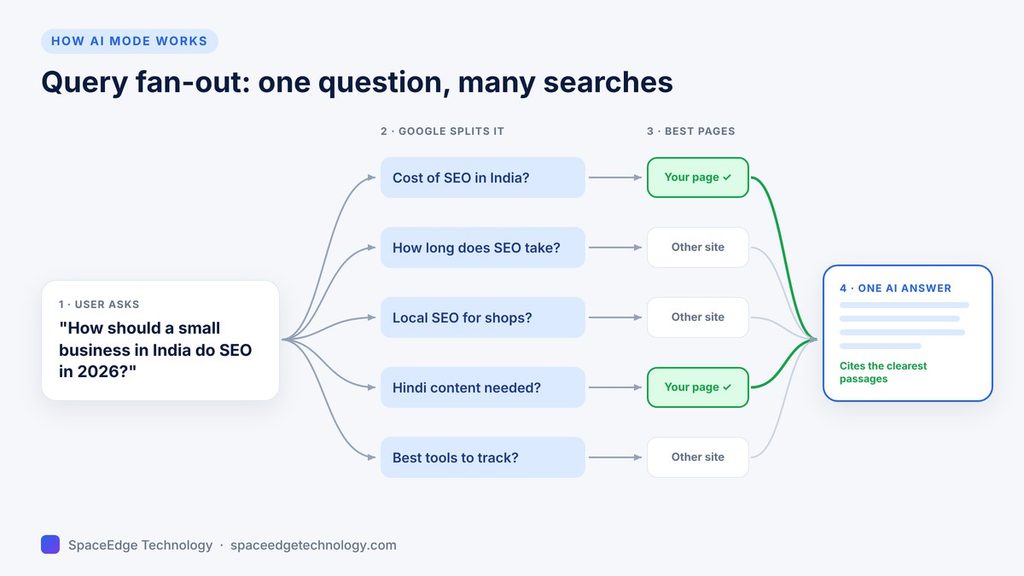
Here is the key idea behind it. AI Mode breaks your question into many smaller questions. Google calls this query fan-out. It then searches for each small question and builds one big answer. So a page that answers one small part very well can still get cited.
AI Overviews vs AI Mode: what is the difference?
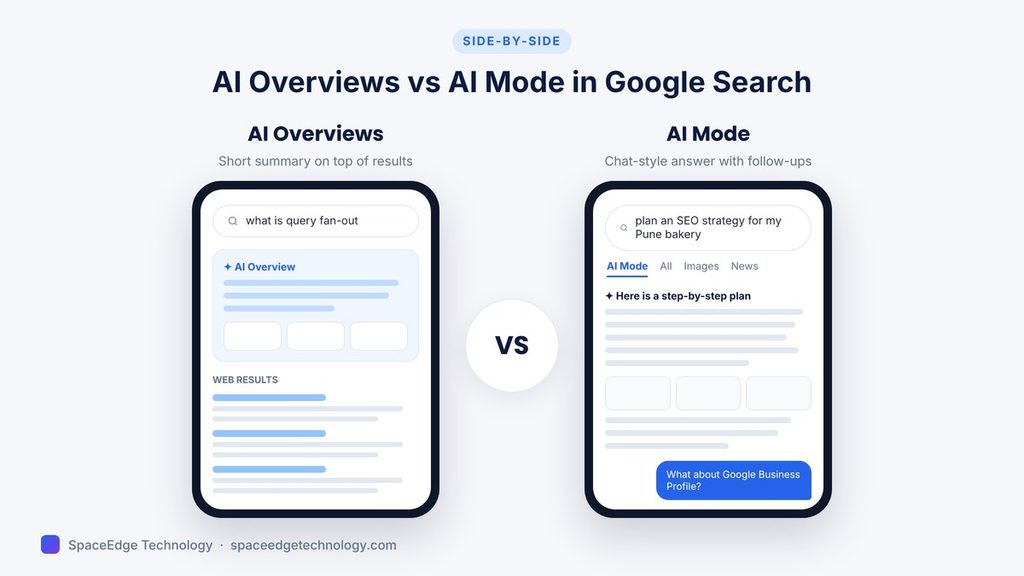
| Feature | AI Overviews | AI Mode |
|---|---|---|
| Where it shows | Top of the normal results page | Its own tab next to All, Images and News |
| Answer length | Short summary | Long, detailed answer |
| Follow-up questions | Limited | Yes, like a chat |
| Input types | Text, voice | Text, voice, image, live camera |
| Best for | Quick facts and simple how-tos | Research, comparisons, planning |
| How you win | Clear, direct answers near the top | Covering many related sub-questions well |
Google says the two features may use different models and techniques. That means the links each one shows can differ for the same query. You should plan for both.
Why India matters so much for AI search in 2026
India is not a side market for these features. It is a lead market. Here is what has happened so far:
- June 2025: Google launched AI Mode in India, its first market outside the US. It ran on a custom version of Gemini 2.5 and supported voice and image search from day one.
- Mid-2025: AI Mode opened to all Indian users in English. No sign-up, no subscription.
- October 2025: Google brought Search Live to India in English and Hindi. It also added seven more Indian languages to AI Mode: Bengali, Kannada, Malayalam, Marathi, Tamil, Telugu and Urdu.
- March 2026: Google India made AI Mode a premier partner of IPL 2026 with the BCCI, putting AI search in front of crores of cricket fans.
Two more facts shape the Indian playbook. First, Google has said more people use Google Lens in India than in any other country. Second, early Indian testers typed questions two to three times longer than normal searches. Longer questions mean more fan-out, and more chances for niche pages to be cited.
In short, Indian users ask longer questions, in more languages, often by voice or camera. Your content strategy has to match that.
How Google picks sources for AI Overviews and AI Mode
Google has been clear on one point. There is no secret trick for AI features. Its official guide says normal SEO best practices still apply. It also says you do not need any special schema to appear. To be shown, a page must be indexed and eligible to show a snippet in normal search.
So the process works in two stages.
- Getting shortlisted. Google’s normal ranking systems find the best pages for the query and its sub-questions.
- Getting cited. Gemini reads those pages and picks the passages that answer each part most clearly.
Ranking gets you into the room. Clear writing gets you named.
AI Overviews ranking factors in 2026: what the data says
Google does not publish a list. But several large studies in 2026 looked at millions of AI answers. Their findings point the same way.
| Factor | What studies found | What it means for you |
|---|---|---|
| Organic ranking | About 84% of top AI Overview citations come from pages already ranking in normal results (Surfer). Around 97% come from the top 20 (industry analysis). | Classic SEO is still the base. |
| First paragraph | The strongest citation factors all relate to what your opening paragraph does (Surfer). | Answer the question at the very top. |
| Definite language | Cited text used firm, clear statements almost twice as often as uncited text (36.2% vs 20.3%). | Say “X is Y”, not “X might perhaps be Y”. |
| Freshness | Pages updated within 30 days were cited about 3.2 times more often (Quattr). | Review key pages every month. |
| Topic coverage | Pages ranking for many related queries were 161% more likely to appear. | Answer the sub-questions, not just the main one. |
| Video | YouTube became the most-cited domain in AI Overviews (Ahrefs). | Pair key articles with a short video. |
| Structured data | About 65% of pages cited in AI Mode used schema markup. | Schema is not required, but it helps machines read you. |
One warning before we move on. Ranking first is no longer a guarantee. Ahrefs found the top result gets about 58% fewer clicks when an AI Overview appears. Some studies also show a growing share of cited pages sit outside the top 10. That is a threat for big sites and a real opening for small, focused ones.
Is being cited worth it if clicks go down?
Yes. A study by Seer Interactive of over 3,000 queries found that brands cited in AI Overviews got a higher organic click rate than brands that were not cited. Cited brands also earned 91% more paid clicks. Being named by Google builds trust, and trust turns into searches for your brand later.
The India playbook: 10 steps to get cited in AI Overviews and AI Mode
Step 1: Pick questions, not just keywords
People talk to AI Mode the way they talk to a friend. So stop chasing only two-word keywords. Start with full questions your buyers ask.
Where to find them:
- The “People also ask” box on Google
- The follow-up questions AI Mode suggests after its answer
- Search Console queries with five or more words
- Calls, WhatsApp chats and emails from your own customers
- Hindi or Hinglish versions of the same question, such as “best CA near me kaise dhundhe”
Group the questions by topic. Each group becomes one strong page.
Step 2: Write answer-first sections
This is the single biggest change you can make. Every section should open with the answer.
Use this simple pattern:
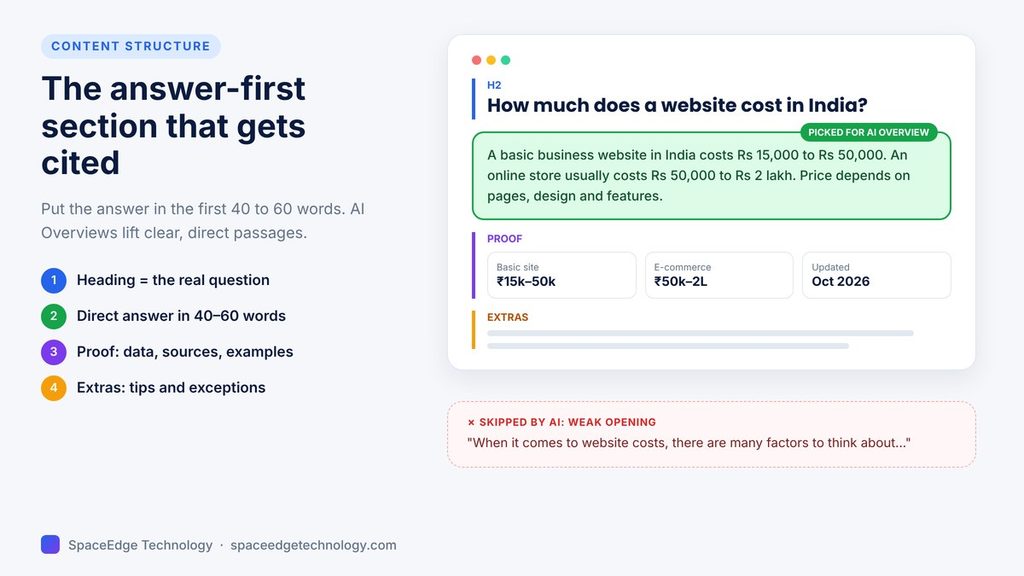
- Heading = the question. Example: “How much does a website cost in India?”
- First 40 to 60 words = the direct answer. Give the number, the steps or the verdict.
- Next = the proof. Add details, examples, data and sources.
- Then = the extras. Tips, exceptions and related points.
Bad opening: “When it comes to website costs, there are many factors to think about.”
Good opening: “A basic business website in India costs Rs 15,000 to Rs 50,000. An online store usually costs Rs 50,000 to Rs 2 lakh. Price depends on pages, design and features.”
The second one can be lifted straight into an AI answer. The first one cannot.
Step 3: Add facts, numbers and sources
AI systems prefer content they can trust. Vague claims get skipped. Specific claims get cited.
- Use real numbers with units and dates.
- Name the source of every statistic and link to it.
- Share your own data, such as results from your projects or a small customer survey.
- Add short expert quotes from real people on your team.
Original data is a strong signal. Several 2026 studies found pages with no original data were rarely cited, even when well written.
Step 4: Cover the whole topic with clusters
Remember query fan-out. When someone asks AI Mode a big question, Google searches many small ones. If your site answers most of them, you get cited more often.
Build a topic cluster:
- One pillar page on the main topic, like “SEO for small businesses in India”.
- Five to ten support posts, each answering one sub-question in depth.
- Internal links from every support post to the pillar, and back.
Google’s own guide lists internal links as a way to help your content get found. A regularly updated SEO blog is the easiest place to grow clusters.
Step 5: Show real experience (E-E-A-T)
E-E-A-T stands for Experience, Expertise, Authoritativeness and Trust. It matters even more when an AI is choosing whom to quote.
- Add an author name, photo and short bio to every post.
- Show first-hand proof: screenshots, photos from the field, before-and-after results.
- Keep a clear About page that explains who you are and how long you have worked.
- Show your full business address, phone number and GST details where relevant.
- For health, money or legal topics, get content reviewed by a qualified expert and say so.
Step 6: Fix technical health first
If Google cannot crawl or render a page, it cannot cite it. Check these basics:
- The page is indexed. Use the URL Inspection tool in Search Console.
- robots.txt does not block Googlebot.
- No “nosnippet” or tight “max-snippet” tags on pages you want cited.
- Main text sits in plain HTML, not hidden inside images, PDFs or tabs that need clicks.
- The page loads fast on a budget Android phone over 4G. Most Indian users search on mobile.
- Core Web Vitals are in the green.
A fast, mobile-first website on reliable web hosting solves most of these problems at the root.
Step 7: Build brand mentions across the web
AI answers often cite third-party pages, not just brand sites. So you want to be mentioned where your buyers already look.
- Get listed in trusted Indian directories and industry associations.
- Answer questions on Quora and Reddit under your real name.
- Earn coverage in news sites and niche blogs with useful data.
- Collect genuine Google reviews and reply to every one.
- Stay active on LinkedIn, Instagram and YouTube with consistent social media optimization.
Check which sites AI Overviews cite for your top queries. Then work to get your brand mentioned on those exact sites.
Step 8: Use tables, lists and clean formatting
AI models love content that is easy to pull apart. Make each idea its own small block.
- Use one H1, then clear H2 and H3 headings in order.
- Keep paragraphs to two or three short sentences.
- Use numbered lists for steps and bullets for features.
- Use tables for comparisons, prices and specs.
- Add a short FAQ at the end with real questions.
Step 9: Add structured data the right way
Google says schema is not required for AI features. Still, it helps machines understand what each part of your page is. Use the types that match your content:
- Article for blog posts, with author and date
- FAQPage for question-and-answer sections
- LocalBusiness for your address, hours and phone
- Product and Review for e-commerce pages
- BreadcrumbList for site structure
Only mark up content that is visible on the page. Test it with Google’s Rich Results Test.
Step 10: Keep content fresh
AI answers lean towards recent content. Make freshness a habit, not a one-time job.
- Review your top 20 pages every month.
- Update prices, years, laws and statistics.
- Add new sub-questions you see in Search Console.
- Change the “last updated” date only when you make real changes.
How to rank in Google AI Mode in Hindi and regional languages
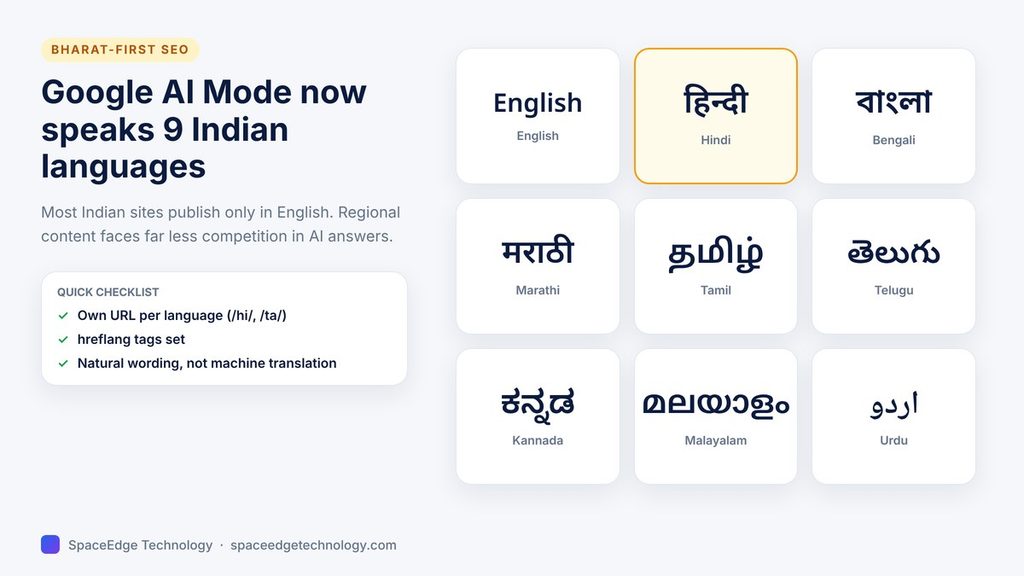
AI Mode now answers in Hindi, Bengali, Kannada, Malayalam, Marathi, Tamil, Telugu and Urdu, as well as English. Most Indian websites still publish only in English. That gap is your chance.
How to do regional content well:
- Write for the language, do not just translate. Use words people actually speak. A farmer in Maharashtra and a student in Delhi phrase the same question differently.
- Give each language its own URL, such as /hi/ or /ta/. Do not mix two languages on one page.
- Add hreflang tags so Google knows which version to show to whom.
- Translate the title, meta description, headings and alt tags too, not only the body.
- Start with your top five pages. Test results before you translate the whole site.
- Cover Hinglish queries in English pages where it fits, because many people type Hindi in Roman script.
Voice search and Google Lens: India’s hidden advantage
Indians use voice and camera search more than most. AI Mode supports both. Here is how to show up.
For voice search:
- Answer questions in 30 words or less at the top of a section.
- Use natural, spoken phrasing such as “How do I…” and “What is the best…”.
- Target “near me” and city-based questions for local businesses.
For Google Lens and image search:
- Use your own real photos, not stock images.
- Give every image a clear file name and a descriptive alt tag.
- Place images next to the text that explains them.
- Add product schema with price and availability for online stores.
Local businesses: get cited for “near me” questions
When someone asks AI Mode for “best dentist in Ghaziabad open on Sunday”, Google mixes web pages with Google Business Profile data. To be picked:
- Fill every field of your Google Business Profile, including services, hours and photos.
- Keep your name, address and phone exactly the same everywhere online.
- Ask happy customers for detailed reviews that mention the service and area.
- Create a page for each main service and each city you serve.
- Make it easy to contact you the moment a searcher lands. A click-to-chat button powered by the WhatsApp Business API turns AI-referred visitors into leads quickly.
How to measure AI Overviews and AI Mode traffic
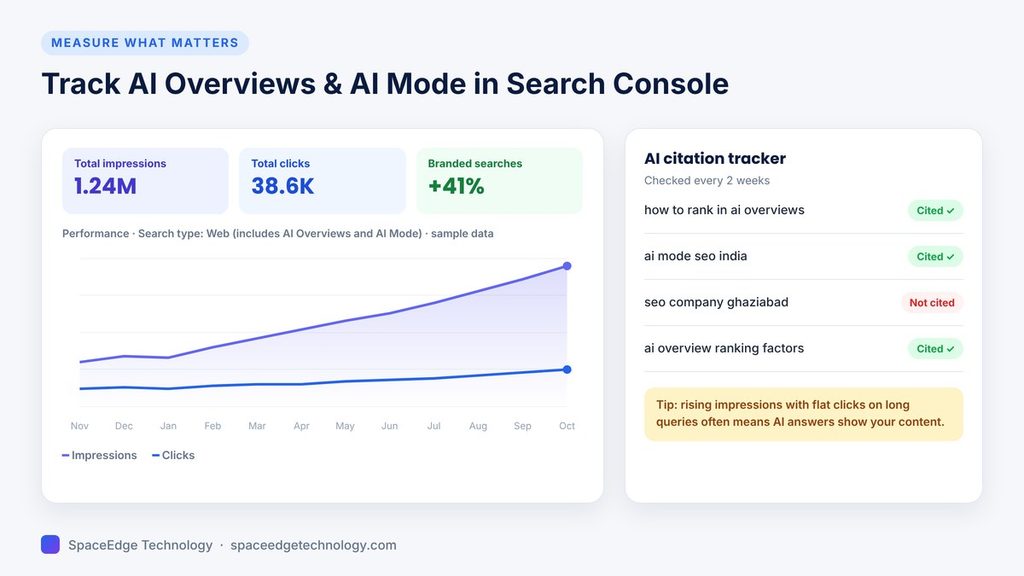
Google counts clicks and impressions from AI Overviews and AI Mode inside the normal Search Console Performance report, under the “Web” search type. They are not always shown as a separate line, so you need a simple tracking routine.
- Make a list of 20 to 50 target questions. Search each one in Google and in AI Mode every two weeks.
- Record three things: does an AI answer appear, is your page cited, and which competitors are cited instead.
- Watch Search Console for long queries where impressions rise but clicks stay flat. That pattern often means AI answers are showing your content.
- Track branded searches. Growth in searches for your brand name is a sign AI citations are building trust.
- Use Google Analytics to measure leads and sales, not only visits.
- Compare with paid data. If you run Google Ads, check whether paid clicks rise on queries where you are also cited.
The goal has shifted from “traffic” to “visibility plus conversions”. A smaller number of AI-referred visitors who already trust you can bring in more business than a large number of casual clicks.
7 common mistakes that stop you from being cited
- Long intros before the answer. If the answer is in paragraph five, the AI picks someone else.
- Thin AI-written pages. Mass-produced content with no new facts or experience rarely gets cited.
- Blocking Google by accident. A stray noindex, nosnippet or robots.txt rule can hide your best page.
- Old numbers. A 2023 price or statistic tells Google the page is stale.
- One giant page for everything. It answers nothing clearly. Split it into a pillar and support posts.
- Fake reviews or fake authors. Trust signals must be real. Fake ones can hurt the whole site.
- Ignoring regional languages. Your competitors in Hindi or Tamil may face almost no one.
Your 30-day action plan
| Week | Focus | Tasks |
|---|---|---|
| Week 1 | Audit | Check indexing and snippet settings. List your top 20 pages and 30 target questions. Note who is cited now. |
| Week 2 | Rewrite | Add a 40-60 word answer under every question heading on your top 10 pages. Add sources and fresh numbers. |
| Week 3 | Build | Publish 3 support posts for your main cluster. Add internal links, author bios and FAQ schema. |
| Week 4 | Expand and track | Translate your top 3 pages into Hindi or your regional language. Update Google Business Profile. Run your first citation check. |
Repeat the cycle every month. Results in AI answers can show within days of Google recrawling an improved page. Lasting gains build over three to six months.
Conclusion
Ranking in Google AI Overviews and AI Mode is not magic. It is good SEO, written more clearly. Rank well, answer fast, prove what you say, and keep it fresh. In India, add languages, voice and local trust signals, and you will be ahead of most competitors.
AI search is still new in India, so early movers win the most. If you want an expert team to handle it, book a free SEO audit with SpaceEdge Technology. We will show you which of your pages can be cited first, and what to fix.
Frequently asked questions
How do I get my website in Google AI Overviews?
Make sure the page is indexed and can show a snippet. Then rank it in the top 20 for the query, and answer the question clearly in the first two sentences of a section. Add sources, keep it updated and cover related sub-questions.
Is AI Mode available in India?
Yes. AI Mode is free for everyone in India on the Google app and on google.com. It works in English, Hindi, Bengali, Kannada, Malayalam, Marathi, Tamil, Telugu and Urdu.
What is the difference between SEO, AEO and GEO?
SEO helps you rank in normal search results. AEO, or answer engine optimization, helps your content become a direct answer. GEO, or generative engine optimization, helps AI tools like Gemini, ChatGPT and Perplexity cite you. In 2026 you need all three, and they share the same base.
Do I need schema markup to appear in AI Overviews?
No. Google says no special schema is required. Still, Article, FAQPage and LocalBusiness schema help machines understand your page, and many cited pages use them.
Does ranking number one guarantee an AI Overview citation?
No. A top ranking helps, but Google cites the passage that answers each sub-question best. A well-structured page in position six can be cited over the top result.
Do AI Overviews reduce website traffic?
They can reduce clicks on simple questions. But brands that get cited often see higher click rates and more brand searches than brands that are left out.
How long does it take to appear in AI Overviews?
A page that already ranks can be cited within days after Google recrawls the improved version. New sites usually need three to six months of steady SEO first.
Can I track AI Mode traffic in Google Search Console?
Yes. AI Overviews and AI Mode clicks and impressions are counted in the Performance report under the Web search type. Pair it with manual checks of your target questions.
Should I write content in Hindi to rank in AI Mode?
If your customers search in Hindi, yes. AI Mode answers in Hindi and seven other Indian languages, and far fewer sites compete there. Write natural content, not machine translations.
Does Google penalise AI-written content in AI Overviews?
Google judges quality, not the tool used. But generic AI text with no original facts or experience rarely gets cited. Add real data, examples and expert review.
Publishing notes
- Headings: inside this doc the article sits under one heading, so its sections show one level lower. In WordPress, set the H1 from the SEO package, make each “###” section an H2 and each “####” an H3.
- Delete the [IMAGE] markers after you upload each picture in that spot with its alt tag.
- Author box: publish under a named expert with a photo and a two-line bio.
- Video: a 2-3 minute YouTube summary embedded under the Quick Answer improves citation chances.
- Length: the article with FAQ runs roughly 4,300 words. To reach 5,000, add a 600-word real case study from one of your client projects (before/after rankings, AI citations won) after Step 3. First-hand results are the strongest E-E-A-T signal and cannot be copied by competitors.
FAQ + Article schema (paste into a Custom HTML block or Rank Math schema)
<script type="application/ld+json">
{
  "@context": "https://schema.org",
  "@graph": [
    {
      "@type": "Article",
      "headline": "How to Rank in Google AI Overviews & AI Mode in 2026: India Playbook",
      "image": "https://spaceedgetechnology.com/wp-content/uploads/rank-in-google-ai-overviews-ai-mode-india-2026.jpg",
      "datePublished": "2026-10-17",
      "dateModified": "2026-10-17",
      "author": {"@type": "Person", "name": "AUTHOR NAME"},
      "publisher": {"@type": "Organization", "name": "SpaceEdge Technology", "url": "https://spaceedgetechnology.com/"},
      "mainEntityOfPage": "https://spaceedgetechnology.com/rank-in-google-ai-overviews-ai-mode-india/"
    },
    {
      "@type": "FAQPage",
      "mainEntity": [
        {"@type": "Question", "name": "How do I get my website in Google AI Overviews?", "acceptedAnswer": {"@type": "Answer", "text": "Make sure the page is indexed and can show a snippet. Rank it in the top 20, answer the question clearly in the first two sentences of a section, add sources, keep it updated and cover related sub-questions."}},
        {"@type": "Question", "name": "Is AI Mode available in India?", "acceptedAnswer": {"@type": "Answer", "text": "Yes. AI Mode is free for everyone in India and works in English, Hindi, Bengali, Kannada, Malayalam, Marathi, Tamil, Telugu and Urdu."}},
        {"@type": "Question", "name": "Do I need schema markup to appear in AI Overviews?", "acceptedAnswer": {"@type": "Answer", "text": "No. Google says no special schema is required, but Article, FAQPage and LocalBusiness schema help machines understand your page."}},
        {"@type": "Question", "name": "Does ranking number one guarantee an AI Overview citation?", "acceptedAnswer": {"@type": "Answer", "text": "No. Google cites the passage that answers each sub-question best, so a well-structured lower-ranked page can be cited over the top result."}},
        {"@type": "Question", "name": "Can I track AI Mode traffic in Google Search Console?", "acceptedAnswer": {"@type": "Answer", "text": "Yes. AI Overviews and AI Mode traffic is counted in the Performance report under the Web search type."}}
      ]
    }
  ]
}
</script>