
Quick answer
Use Instagram Reels if you sell to local customers, run a visual brand, or want people to message you and buy fast. Use YouTube Shorts if you want videos that show up in search, keep getting views for months, and lead people to longer videos. For most businesses in 2026, the best plan is to make one vertical video and post it on both, then put more effort into the platform that brings you leads.
Here is the short version in one line each:
- Instagram Reels: best for brand awareness, local reach, quick sales and direct messages.
- YouTube Shorts: best for search traffic, long-term views and building trust through longer content.
- Both: best for almost everyone, because one video can work on two platforms with small edits.
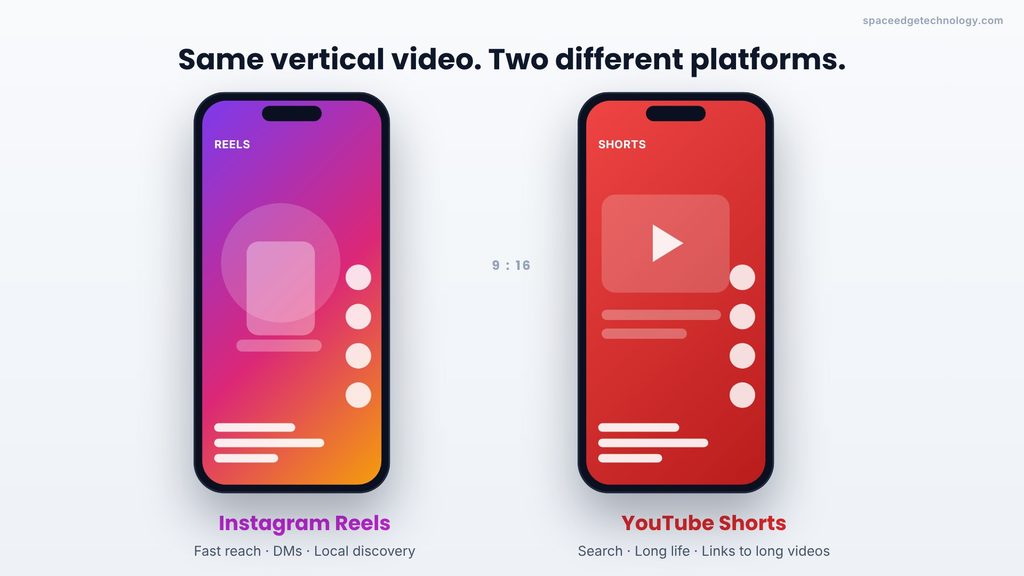
Picking between Instagram Reels and YouTube Shorts is one of the most common questions business owners ask us. Both apps are huge. Both push short vertical videos to people who do not follow you yet. But they reward different things, and they suit different goals.
This guide explains how each platform works in 2026, compares them side by side, and tells you which one fits your type of business. You will also get a simple plan to use both without doubling your work. If you would rather have experts handle it, our social media optimization services cover Reels and Shorts from planning to reporting.
What are Instagram Reels and YouTube Shorts?
Instagram Reels and YouTube Shorts are short, vertical videos made for phones. Both fill the whole screen. Both play one after another as people swipe up. And both are built to show your video to strangers, not just your followers.
That last part is why businesses care. A new account with zero followers can still get thousands of views if the video is good. That was much harder with old-style posts.
What is Instagram Reels?
Reels is Instagram’s short video format. It launched in 2020. Reels show up in a few places: the Reels tab, the main feed, the Explore page, your profile grid, and inside direct messages when people share them.
Reels now sit at the center of Instagram. Meta said in September 2025 that Instagram had reached 3 billion monthly users, and reports at the time said Reels made up more than half of the time people spend in the app. Instagram has even tested opening the app straight to the Reels feed in some countries, including India.
For businesses, Reels connect to everything else Meta offers. A viewer can tap your profile, send you a message, visit your shop, or click a link. You can also turn a Reel into an ad in a few taps.
What is YouTube Shorts?
Shorts is YouTube’s short video format. It sits inside the YouTube app, next to normal long videos, live streams and podcasts. Shorts appear in the Shorts feed, on the YouTube home page, in search results, and on your channel.
Shorts is massive. YouTube says Shorts average more than 200 billion daily views. YouTube first shared that number in June 2025 and repeated it in 2026.
The big difference is what sits around Shorts. YouTube is also the world’s biggest video search engine. People go there to learn, compare products and solve problems. A Short can lead a viewer to your full-length video, your channel, or your website.
Key 2026 facts at a glance
| Fact | Instagram Reels | YouTube Shorts |
|---|---|---|
| Parent company | Meta | |
| Monthly users (whole app) | 3 billion (Meta, September 2025) | About 2.7 billion (reported 2025) |
| Daily plays | Over 200 billion across Instagram and Facebook Reels (Meta) | Over 200 billion Shorts views per day (YouTube) |
| Max length | 3 minutes for most accounts; some accounts can upload longer | 3 minutes (since October 2024) |
| Best-performing length | Often 7 to 30 seconds | Often 15 to 60 seconds |
| Video shape | Vertical 9:16 | Vertical 9:16 (or square) |
| Built-in ads | Meta Ads Manager | Google Ads |
| Creator earnings | Mostly brand deals and bonuses in some regions | 45% share of Shorts ad pool for YouTube Partner Program members |
One note on video length. Both apps now allow up to about 3 minutes, and Instagram has tested even longer uploads. But longer is not better. Both apps reward videos people watch to the end. A tight 20-second video that people replay usually beats a 2-minute video that people skip.
Numbers like these change often. Always check the app itself before planning a big campaign.
Instagram Reels vs YouTube Shorts: Side-by-Side Comparison
Reels win on fast reach, local discovery and direct sales. Shorts win on search, video lifespan and leading people to deeper content. The table below sums it up, and the sections after it explain each point in plain words.
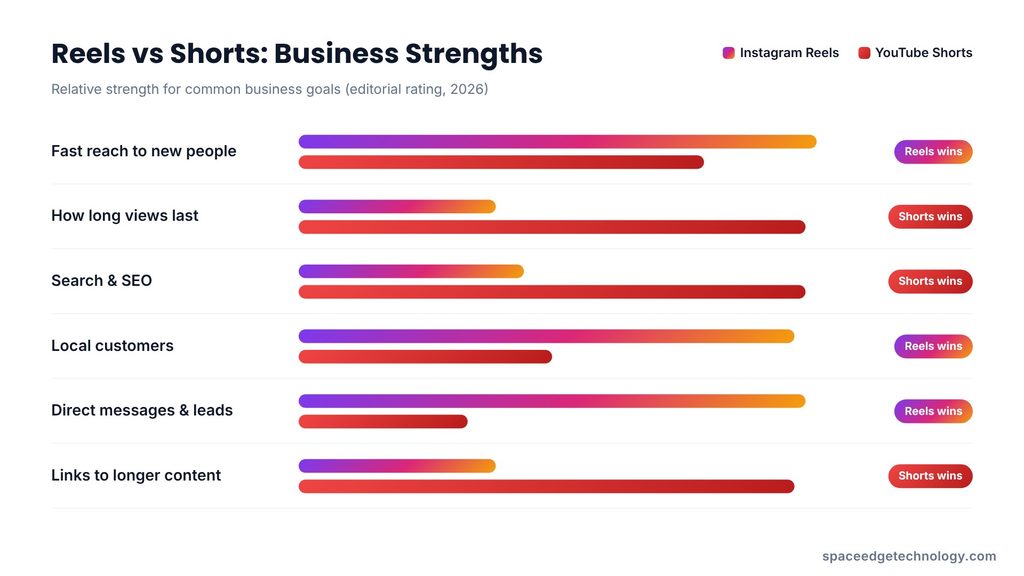
| Factor | Instagram Reels | YouTube Shorts | Winner for most businesses |
|---|---|---|---|
| Fast reach to new people | Very strong in first 24 to 48 hours | Strong, but often slower to build | Reels |
| How long views last | Days to a few weeks | Months, sometimes years | Shorts |
| Search and SEO | Growing, but limited | Strong; YouTube and Google both show Shorts | Shorts |
| Local customers | Strong, with location tags and local Explore | Weaker for local | Reels |
| Direct messages and leads | Built in, easy | Comments only; no DMs | Reels |
| Link to longer content | Limited | Built-in “related video” link | Shorts |
| Shopping | Product tags and shops in many regions | Product tagging for eligible channels | Tie (depends on region) |
| Paid ads | Meta Ads, very easy to boost | Google Ads, strong targeting by intent | Tie |
| Creator earnings | No standard ad share | 45% of Shorts ad pool for partners | Shorts |
| Analytics | Simple and quick | Deeper (YouTube Studio) | Shorts |
Reach: who sees your video first?
Both apps push your videos to people who do not follow you. This is the main reason short video is so useful for small brands.
On Instagram, a large share of Reels views comes from non-followers. Instagram’s head, Adam Mosseri, has said watch time, likes per reach and shares by direct message are the biggest signals for Reels. If people send your Reel to friends, Instagram shows it to more people.
On YouTube, Shorts reach is also driven by strangers. Third-party studies suggest roughly three out of four Shorts views come from people who are not subscribed. YouTube looks at whether viewers watch, replay, or swipe away.
The real difference is speed. Reels tend to get most of their views quickly. Shorts can start slow and then pick up weeks later when YouTube finds the right audience. So if you need buzz this weekend for a sale, Reels usually move faster.
Lifespan: how long do views keep coming?
This is where YouTube Shorts pull ahead. A Reel is like a shop window display. It gets attention for a short time, then fades. Meta has also said recent posts now make up a growing share of recommended Reels, so fresh content matters even more.
A Short is more like a sign on a busy road. It can keep sending people to you for months. That is because YouTube is a search engine. When someone types a question, your Short can still appear, long after you posted it.
For a business with a small team, that matters. Every Short you make adds to a library that keeps working. Every Reel needs to be followed by another one soon.
Search and SEO: can people find you later?
YouTube is the second largest search engine in the world, after Google. Shorts show up in YouTube search, and Google also shows Shorts in its own results and video sections. A title like “How to fix a leaking tap in 30 seconds” can bring in viewers for years.
Instagram search has improved. Captions, keywords in your profile name, and on-screen text all help Reels get found. Instagram posts from professional accounts can also show up in Google search. But most Reels views still come from the feed, not from search.
If you want short videos that support your website’s search rankings and bring steady traffic, Shorts are the stronger pick. Pair them with good SEO services so your videos, website and Google Business Profile all point to each other.
Audience: who watches each platform?
Both apps reach almost every age group. Still, there are useful patterns.
- Instagram leans toward people aged 18 to 34. It is strong for fashion, beauty, food, travel, fitness, home decor and local services.
- YouTube reaches a wider age range, including older adults. Industry studies show the largest Shorts age group is 25 to 34. People on YouTube are often in “learn mode” — looking for tutorials, reviews and comparisons.
A simple way to think about it: people open Instagram to see what friends and favorite brands are up to. People open YouTube to watch, learn or solve something. Your content should match that mood.
Engagement: likes, comments and shares
Reels usually get more likes, comments and shares per view. Instagram is a social app first, so people react more. Sharing a Reel in a direct message is very common, and that sharing spreads your video quickly.
Shorts often get more views but fewer reactions per view. One industry study found comments on only a tiny share of Shorts views. That is not bad. It simply means Shorts viewers watch more and talk less.
For a business, the question is which action matters most. If you want conversations and messages, Reels fit. If you want views that turn into subscribers and later customers, Shorts fit.
Turning views into leads and sales
Views alone do not pay the bills. Here is how each platform helps you turn a viewer into a customer.
On Instagram, the path is short. A viewer watches your Reel, taps your profile, and sends a message or taps your link. Many businesses add automatic replies to messages, so a comment like “PRICE” triggers a reply with details. You can also connect Instagram leads to the WhatsApp Business API and follow up in a chat your customer already uses every day.
On YouTube, the path is longer but deeper. A viewer watches your Short, taps the related video link, watches a full 8-minute guide, and then visits your website. By then, they trust you. That trust often leads to bigger sales.
Whichever platform you use, have a clear place for people to land. A fast, mobile-friendly site built through professional website design makes a big difference. So does following up with WhatsApp marketing or bulk email marketing once you have a lead’s contact details.
Advertising: Reels ads vs Shorts ads
Both platforms let you pay to reach more people.
Instagram Reels ads run through Meta Ads Manager. You can boost a Reel that is already doing well in a few taps. Targeting by location, age and interest is easy. Reels ads are a good fit for local offers, product launches and lead forms.
YouTube Shorts ads run through Google Ads. Shorts can be one placement inside video campaigns or Demand Gen campaigns. Google lets you target based on what people search for and watch, which is powerful when people are already looking for a product like yours.
Neither is “better” for every business. Meta ads usually win on cheap reach and local targeting. Google ads usually win when buying intent is high. Many brands test both with a small budget first. If you want help setting that up, our PPC and Google Ads management team runs both kinds of campaigns.
Monetization: can your business earn money directly?
Most businesses make money from customers, not from platform payouts. Still, it helps to know the rules.
YouTube Shorts shares ad money with creators in the YouTube Partner Program. To join, you need 1,000 subscribers plus either 4,000 public watch hours on long videos in 12 months or 10 million valid Shorts views in 90 days. YouTube pools the ad money from the Shorts feed and gives partners 45% of their share. Earnings per view are small, but they add up for media and education brands.
Instagram Reels has no standard ad revenue share. Instagram has run bonus programs in some regions, and creators earn mostly through brand deals, subscriptions and gifts.
For a normal business, treat platform earnings as a bonus. The real value is leads and sales.
Analytics: measuring what works
Instagram Insights is simple. You can see reach, plays, watch time, shares, saves and follows from each Reel. That is enough for most small teams.
YouTube Studio goes deeper. You see where viewers came from, how many stopped watching at each second, which search terms found you, and how many viewers went on to watch your long videos. If you like data, YouTube gives you more to work with.
Which Platform Should Your Business Use?
The right choice depends on two things: what kind of business you run, and what you want each video to do. Start with your goal, then check your business type.
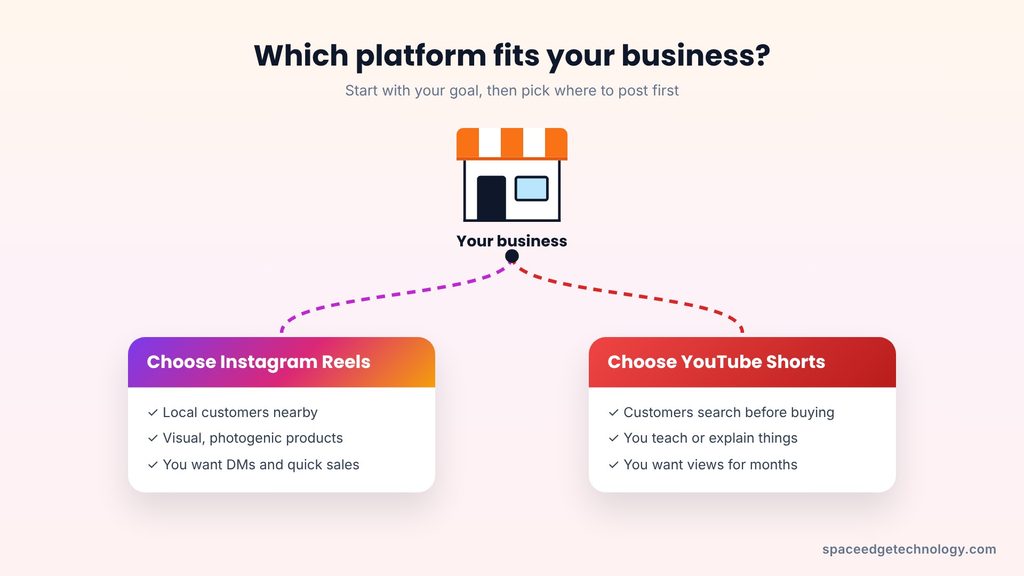
Choose by goal
| Your main goal | Better platform | Why |
|---|---|---|
| Get noticed fast in your city | Instagram Reels | Location tags, local Explore and quick early reach |
| Get messages and enquiries | Instagram Reels | Direct messages are built in and easy to use |
| Sell products on impulse | Instagram Reels | Visual app, product tags, easy to boost as ads |
| Show up in search for months | YouTube Shorts | YouTube search and Google results |
| Build trust for big purchases | YouTube Shorts | Shorts lead viewers to full-length videos |
| Teach or explain something | YouTube Shorts | Viewers come to YouTube to learn |
| Grow a personal brand or media channel | Both, with Shorts as the long-term base | Shorts earn ad share and build a library |
Choose by business type
Restaurants, cafes, salons, gyms and local shops. Start with Instagram Reels. Local customers scroll Instagram to decide where to eat, train or get a haircut. Show your space, your team and your best dishes or results. Tag your location every time. Add Shorts later once you have a steady routine.
Fashion, beauty, jewelry and home decor brands. Lead with Reels. These are visual products, and Instagram is a visual app with strong shopping habits. Use Shorts for “how to style” and “how to use” videos that people search for.
Real estate agents and builders. Use both. Reels work well for quick property tours and local market updates. Shorts work well for answers to common questions, such as “What is carpet area?” or “How much down payment do I need?” — those questions get searched again and again.
Coaches, consultants, trainers and education businesses. Lead with YouTube Shorts. People search YouTube to learn. A Short that answers one question can send viewers to your long lesson, and then to your course or consultation page.
B2B, software and IT companies. Lead with YouTube Shorts, and support with Reels for culture and hiring. Your buyers research before they buy. Shorts that explain a feature, share a quick tip or answer a common objection keep working while your sales team sleeps.
Doctors, clinics and health brands. Use Shorts for simple, accurate explainers that people search for. Use Reels for clinic tours, team introductions and patient education reminders. Always follow medical advertising rules in your country.
Ecommerce stores. Use both, and test hard. Reels with product tags and Meta ads often drive quick sales. Shorts product demos and reviews bring in searchers who are close to buying.
Instagram Reels vs YouTube Shorts for small business owners
If you have a small team and little time, here is a simple rule. Pick the platform where your customers already spend time, and post there three times a week for 90 days. Then copy your best videos to the second platform with small changes.
Do not try to be perfect on both from day one. It is better to be steady on one than to quit both after a month.
When Reels is the clear winner
- Your customers live nearby and visit you in person.
- Your product looks great on camera.
- You want people to message you directly.
- You need results from a campaign within days.
When Shorts is the clear winner
- Your customers search for answers before buying.
- You already make, or plan to make, long YouTube videos.
- You want each video to keep working for months.
- Your audience includes people over 35.
How to Use Reels and Shorts Together (Without Double the Work)
You can post the same video on both platforms. Neither Instagram nor YouTube bans it. The trick is to make small changes for each app, and never upload a video with another app’s watermark on it. Instagram has said it may show watermarked videos to fewer people.
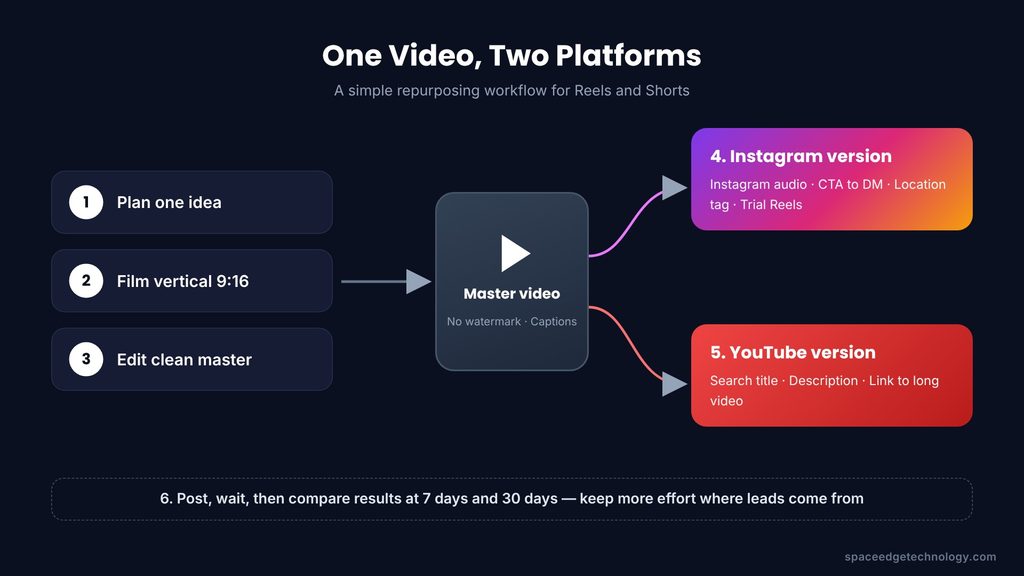
A simple 6-step repurposing workflow
- Plan one idea per video. Pick one question, one tip or one product. Short videos fail when they try to say three things.
- Film in vertical 9:16, in good light. Use your phone’s main camera. Keep important text and faces away from the very top and bottom, where buttons cover the screen.
- Edit a clean master copy. Edit in a neutral app such as CapCut, Instagram’s Edits app or your phone’s editor. Export without any watermark. Add captions on screen, since many people watch with the sound off.
- Make the Instagram version. Use trending or licensed audio from Instagram’s library. Write a caption with a clear call to action, such as “Send us a message with the word PRICE.” Add a location tag and 3 to 5 relevant hashtags. Try Trial Reels to test the video on non-followers first.
- Make the YouTube version. Write a search-friendly title, such as “How to Clean a Sofa in 60 Seconds.” Add a short description with your main keyword. Link the Short to a related long video if you have one. Use YouTube’s audio library to avoid copyright problems.
- Post, wait, and compare. Check results after 7 days and again after 30 days. Shorts often grow later, so do not judge them too fast.
Writing hooks that work on both apps
The first 2 seconds decide everything. Both apps watch how many people swipe away early. Good hooks are simple and direct.
- Ask a question: “Why does your AC smell bad?”
- Show the result first: Start with the clean sofa, then show how.
- Name a mistake: “Stop doing this when you post Reels.”
- Give a number: “3 signs your website is losing customers.”
Say the hook out loud and put it on screen as text. That way it works with or without sound.
Content ideas that work for businesses
- Behind the scenes: how you make, pack or deliver your product.
- Quick tips: one useful tip your customers will thank you for.
- Before and after: results from your service, with permission.
- Answer a common question: take one question from your inbox each week.
- Customer stories: a short clip of a happy customer, with consent.
- Myth vs fact: clear up something people get wrong about your industry.
- Team intros: show the faces behind your business to build trust.
- Product demos: show the product working in 15 to 30 seconds.
Writing titles and captions faster
Titles matter more on YouTube. Captions matter more on Instagram. AI tools can help you draft both quickly, as long as you edit them to sound like you. Our guide on ChatGPT for SEO has prompts you can adapt for video titles and descriptions.
Keep a simple keyword list for your business. Use those words naturally in YouTube titles, Instagram captions and on-screen text. This helps both apps understand what your video is about.
Keep your branding consistent
Use the same colors, fonts and logo placement on every video. Viewers should know it is you within a second. A short branded intro is not needed, and it can hurt retention. A small logo in the corner or a consistent color style works better. If your logo is old or hard to read on a small screen, a refresh through professional logo and brand design can help.
How often should you post?
Consistency beats volume. For most small businesses, 3 Reels and 3 Shorts a week is a strong, realistic target. If that is too much, start with 2 a week on each and build from there.
Post when your audience is online. Check Instagram Insights and YouTube Studio for your best times after a few weeks.
Common Mistakes Businesses Make With Short Videos
Most short video failures come from the same few habits. Avoid these and you will be ahead of many competitors.
- Posting ads instead of content. People skip videos that feel like TV commercials. Teach, entertain or show something real first. Sell second.
- A slow start. A logo animation or “Hi everyone, welcome back” loses viewers. Start with the hook.
- Uploading with a watermark. A TikTok or Instagram logo on a YouTube Short, or the other way around, can reduce reach.
- No call to action. Tell people exactly what to do next: message, comment, visit, or watch the full video.
- Using copyrighted music. Use each app’s own audio library. On YouTube, copyrighted music can also cut or remove Shorts earnings.
- Judging Shorts too quickly. A Short with low views in week one can still take off in week four.
- Chasing views instead of customers. A video with 2,000 views that brings 10 enquiries beats one with 200,000 views and no leads.
- Quitting too early. Short video takes about 2 to 3 months of steady posting to show a clear pattern.
How to Measure Results on Reels and Shorts
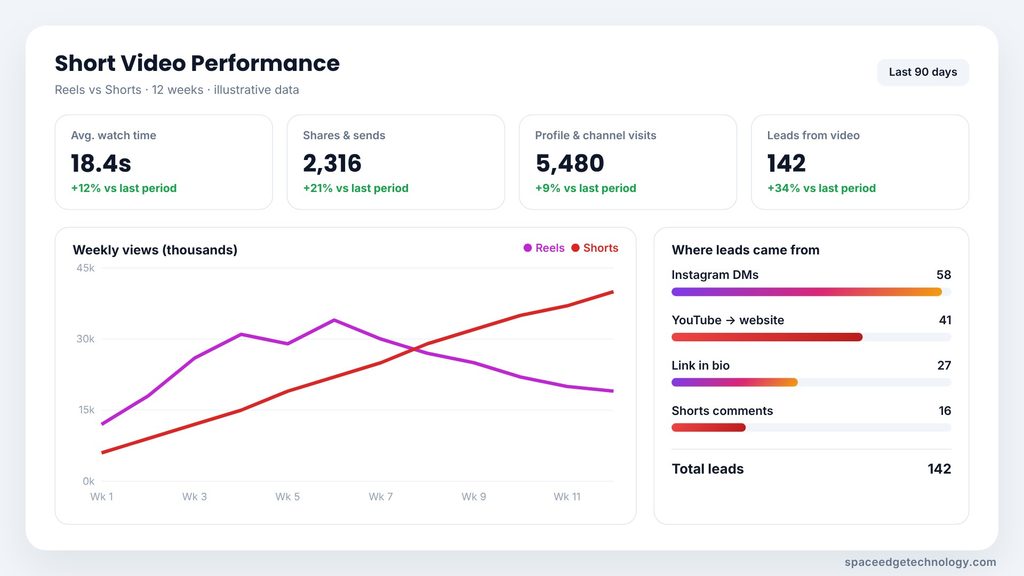
Track the numbers that connect to sales, not just the ones that feel good. Check them once a week and write them down in a simple sheet.
| Metric | What it tells you | Where to find it |
|---|---|---|
| Average watch time / retention | Whether your video holds attention | Instagram Insights; YouTube Studio |
| Shares and sends | Whether people find it worth passing on | Instagram Insights; YouTube Studio |
| Profile visits / channel views | Whether viewers want more from you | Both apps |
| Follows / subscribers gained | Whether you are building an audience | Both apps |
| Link clicks and website visits | Whether views turn into traffic | Instagram Insights; Google Analytics |
| Messages and enquiries | Whether views turn into leads | Instagram inbox; WhatsApp; your CRM |
| Sales or bookings | The final result | Your sales records |
Add a simple tracking tag (UTM) to links in your bio and video descriptions. That way Google Analytics shows exactly how many visitors came from Reels or Shorts. Ask new customers, “How did you find us?” too. It is free and surprisingly useful.
After 90 days, compare the two platforms by leads, not views. Then put more of your time where the leads come from.
The Verdict: Reels or Shorts in 2026?
There is no single winner, because the two apps do different jobs.
- Instagram Reels is your fast, social, local tool. It gets you noticed quickly and turns viewers into conversations.
- YouTube Shorts is your long-term, searchable tool. It keeps bringing in viewers and builds trust over time.
For most businesses, the smartest move in 2026 is to make one strong vertical video, adapt it for both apps, and then follow the leads. Start with the platform your customers use most. Add the second one once you have a routine.
Short video works best as part of a bigger plan that includes search, ads, a fast website and good follow-up. SpaceEdge Technology has helped businesses grow online since 2008 with social media optimization services, SEO, paid ads and messaging. If you want a clear plan for Reels and Shorts, book a free marketing audit and our team will show you where to start. For more guides like this, visit our blog.
Frequently Asked Questions
Which is better for business, Instagram Reels or YouTube Shorts?
Neither is better for every business. Instagram Reels is better for local reach, visual products and getting direct messages. YouTube Shorts is better for search traffic, long-lasting views and building trust. Most businesses get the best results by posting on both and focusing on the one that brings more leads.
Can I post the same video on Reels and Shorts?
Yes. You can post the same video on both platforms. Remove any watermark first, use each app’s own music library, and change the caption and title to suit each platform. A search-friendly title helps on YouTube. A clear call to action helps on Instagram.
Do YouTube Shorts get more views than Instagram Reels?
Often, yes, over time. YouTube Shorts can keep getting views for months because they appear in search. Instagram Reels usually get most of their views in the first few days. Your results depend on your content, your niche and how often you post.
Which platform is better for a small business?
For a local small business like a cafe, salon or shop, Instagram Reels is usually the best place to start. For a service business where people research first, like coaching, IT or real estate, YouTube Shorts is often the better start. Pick one, post steadily for 90 days, then add the other.
How long should a Reel or Short be in 2026?
Both platforms allow videos up to about 3 minutes, and Instagram has tested longer uploads. For reach, shorter usually works better. Aim for 7 to 30 seconds for Reels and 15 to 60 seconds for Shorts. Make it only as long as the idea needs.
Do YouTube Shorts help SEO?
Yes. Shorts can appear in YouTube search and in Google search results. A clear title with your main keyword, a short description and a link to a related long video all help. Shorts can also send traffic to your website and support your brand’s presence in search.
Can businesses make money from YouTube Shorts?
Yes, through the YouTube Partner Program. You need 1,000 subscribers and either 10 million valid Shorts views in 90 days or 4,000 watch hours on long videos in 12 months. Partners receive 45% of their share of the Shorts ad pool. Most businesses earn far more from leads than from ad share.
Does Instagram pay for Reels?
Instagram does not have a standard ad revenue share for Reels. It has run bonus programs in some regions, and creators earn through brand deals, subscriptions and gifts. For businesses, the value of Reels comes from reach, messages and sales.
Are Reels ads cheaper than YouTube Shorts ads?
It depends on your audience, location and goal. Meta ads on Reels are often cheaper for broad and local reach. Google ads on Shorts can be more efficient when people are already searching for what you sell. Test both with a small budget and compare cost per lead.
How often should a business post Reels and Shorts?
Three times a week on each platform is a strong target for most businesses. If that is too much, start with two a week. Being steady for three months matters more than posting every day for two weeks.
Is TikTok better than Reels and Shorts for business?
TikTok is also strong for short video, especially for younger audiences. But it is not available in every country, including India. Reels and Shorts are available almost everywhere, connect to large ad systems, and work well together.