
Quick answer: Bulk voice call marketing beats SMS and WhatsApp when your audience cannot read well, does not use smartphones or mobile data, speaks a local language, or needs to hear a trusted human voice. It also wins when the message is urgent, when you want an instant reply through a key press (IVR), or when people ignore text messages. SMS is better for short codes, links and receipts. WhatsApp is better for rich media and two-way chat with smartphone users who opted in.
Most businesses pick a messaging channel out of habit. They send SMS because they always have. Or they move to WhatsApp because everyone talks about it. But each channel works best in certain situations. Pick the wrong one and your message gets skipped.
This guide explains bulk voice call marketing in plain words. You will learn how it works, what IVR means, and exactly when a voice call does a better job than a text or a WhatsApp message. You will also see when it does not, so you can spend your budget wisely.
What Is Bulk Voice Call Marketing?
Bulk voice call marketing means sending one recorded voice message to many phone numbers at the same time. A computer system dials the numbers. When a person picks up, they hear your message. No live agent is needed.
People also call it voice broadcasting, voice blast, outbound dialing (OBD) or a pre-recorded voice call campaign. The idea is the same. You record once, and the system delivers it to hundreds or millions of people.
A bulk voice call service usually gives you a dashboard. You upload your contact list, add your audio file, pick a time and press send. After the campaign, you see who answered, how long they listened and what they pressed.
What Is IVR Marketing?
IVR stands for Interactive Voice Response. It lets the listener talk back using the keys on their phone. For example, the message might say, “Press 1 to speak with our sales team. Press 2 to hear the offer again.”
Each key press is a DTMF signal. The system reads it and takes the next step. It can connect the caller to an agent, play another message, send an SMS with a link, or save the answer as a lead.
So a plain voice broadcast is one-way. An IVR call campaign is two-way. IVR marketing turns a simple announcement into a tool that collects leads, feedback and confirmations.
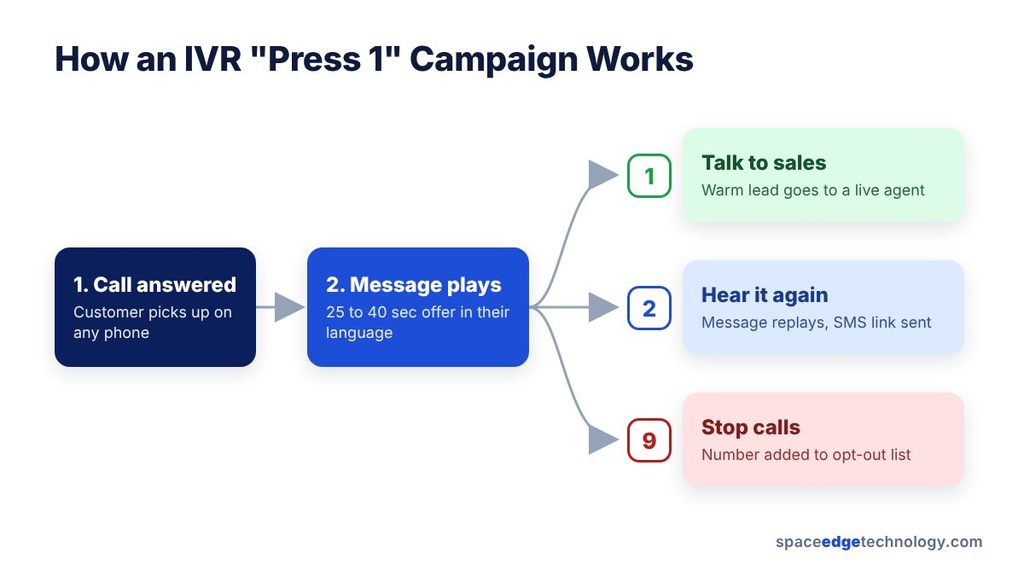
How Does a Bulk Voice Call Campaign Work?
The process is simple. Here is what happens behind the scenes.
- You build your contact list. Only use numbers of people who agreed to hear from you.
- You create the audio. Record a real voice, or type your script and use text-to-speech (TTS).
- You set up the IVR menu (optional). Decide what each key does.
- You schedule the campaign. Pick the day and time slot.
- The system dials the numbers. It calls many numbers at once and retries busy or unanswered ones if you allow it.
- People listen and respond. They hear the message and may press a key.
- You read the report. You see answered calls, listen duration, key presses and failed calls.
The whole setup can take less than an hour once your audio and list are ready.
Types of Bulk Voice Calls
Not every voice campaign is the same. These are the main types.
Promotional voice calls
These share offers, new products, sales or events. In many countries they need clear consent and must follow do-not-call rules. In India, for example, TRAI requires promotional calls to come from the 140 number series, and people can block them through the DND registry (SCC Online summary of TRAI’s July 2026 press note).
Transactional and service voice calls
These share information the customer needs. Think of payment reminders, delivery updates, appointment alerts and account notices. They usually carry no sales pitch. In India, banks and other financial firms must use the 1600 number series for these calls (TRAI direction circular).
IVR survey and feedback calls
These ask short questions. The listener answers with key presses. For example, “Press 1 if you were happy with our service. Press 2 if not.”
Click-to-connect or “press 1” lead calls
These play a short pitch, then connect interested listeners straight to a live agent. Only warm leads reach your sales team.
Public awareness and alert calls
Governments, schools, hospitals and NGOs use these for health drives, exam dates, weather warnings and safety notices.
Bulk Voice Call vs SMS vs WhatsApp: Quick Comparison
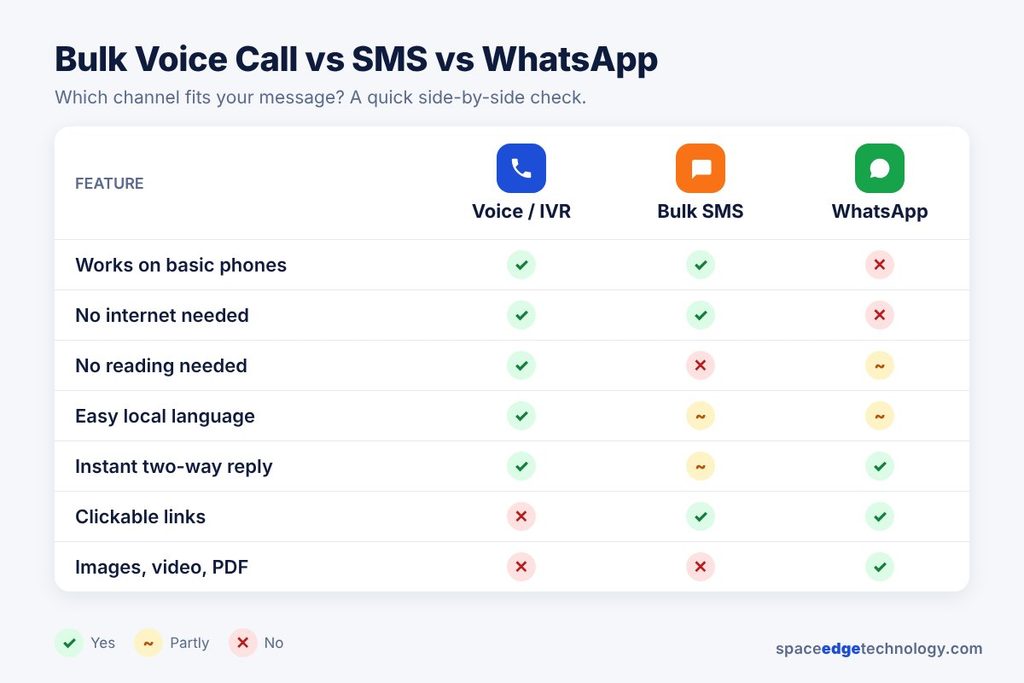
The table below compares the three channels side by side.
| Factor | Bulk voice call / IVR | Bulk SMS | WhatsApp Business |
|---|---|---|---|
| Works on basic phones | Yes | Yes | No, needs a smartphone |
| Needs internet or data | No | No | Yes |
| Needs reading skills | No | Yes | Yes (mostly) |
| Local language and accent | Easy, just record in that language | Possible, but script and character limits apply | Possible |
| Feels personal | High, a real voice | Low to medium | Medium to high |
| Instant two-way reply | Yes, key press or live transfer | Limited (reply SMS or link) | Yes, chat and buttons |
| Rich media (images, video, PDF) | No | No | Yes |
| Clickable links | No (send an SMS follow-up) | Yes | Yes |
| Best length | 20 to 45 seconds | 160 characters per part | Short text plus media |
| Main risk | Unanswered calls, call fatigue | Ignored or filtered texts | Template rules, opt-in needs, per-message fees |
| Best for | Reach, trust, urgency, low literacy | Codes, links, receipts, quick alerts | Rich offers, support, chat commerce |
None of these channels wins every time. The rest of this guide shows when each one is the right pick. For text campaigns, see our promotional bulk SMS and WhatsApp marketing services.
When Bulk Voice Calls Beat SMS and WhatsApp
Here are the clear situations where a voice call does the job better than a text.
1. Your audience cannot read easily
A text message only works if the person can read it. Many people struggle with reading, especially older adults and people who left school early. Others can read their own language but not English or the script you used.
A voice message removes that barrier. If they can hear, they can understand. This makes voice calls a strong choice for farmers, daily-wage workers, rural families and senior citizens.
2. Your audience does not use smartphones or mobile data
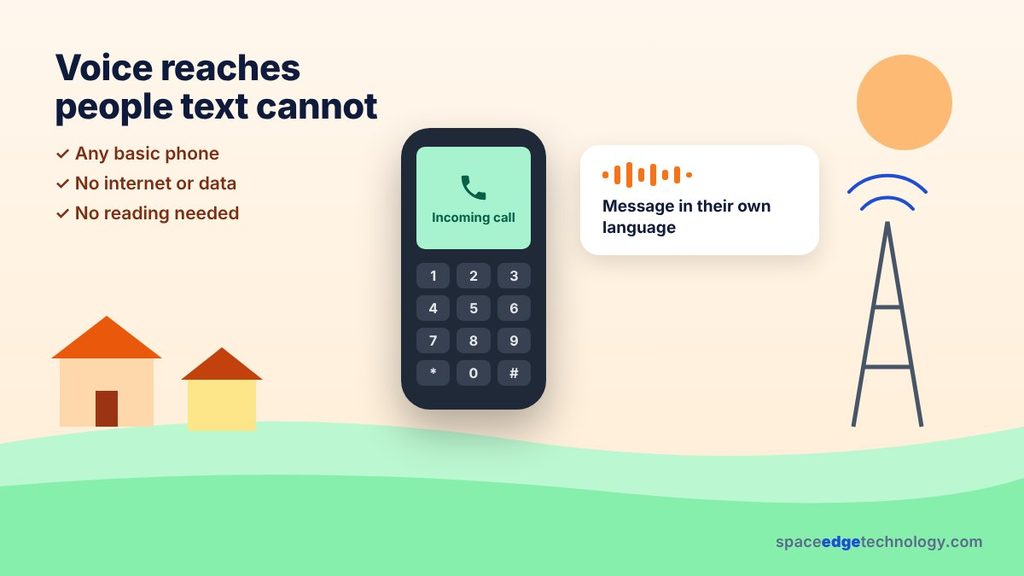
WhatsApp needs a smartphone and an internet connection. Many people still do not have both. The ITU estimates that 2.2 billion people were still offline in 2025, and 96 percent of them live in low- and middle-income countries (ITU Facts and Figures 2025).
Those people cannot see your WhatsApp message at all. But almost all of them can still receive a normal phone call. Voice works on any phone, on any network, with no data plan.
3. You need to speak in a local language or dialect
Written local scripts are hard to display on some phones. Many people speak a dialect that has no common written form. With voice, you just record the message in the language your customers speak at home.
Hearing their own language builds instant comfort. It tells the listener, “This message is for you.” That feeling is hard to create with a short text.
4. The message is urgent
A ringing phone gets attention. A text can sit unread for hours. If you need people to act now, a call is harder to miss.
Good examples include:
- A flight or train delay
- A weather or safety warning
- A last-day payment reminder
- A school closing early
- A product recall
For urgent alerts, send the voice call first. Then follow with an SMS so people have the details in writing.
5. You need trust and a human touch
People trust a familiar voice more than a block of text. This is why politicians, doctors, school heads and business owners often record messages in their own voice.
A short message from a local leader or a brand founder feels personal. It also feels harder to fake than a text full of links, which many people now treat as a possible scam.
6. You want an instant answer from many people
IVR lets thousands of people reply in seconds. They press a key. You get a clean report.
This is useful for:
- Confirming appointments (“Press 1 to confirm, 2 to reschedule”)
- Cash-on-delivery order checks
- Event RSVPs
- Quick polls and surveys
- Interest checks before a sales call
With SMS, people must type a reply, which many will not do. With WhatsApp, buttons work well, but only for smartphone users who opted in.
7. Your SMS results keep dropping
Inboxes are full. Many phones now filter promotional texts into a separate folder. If your SMS clicks or replies keep falling, adding a voice touchpoint can bring back attention. A short call can tell people to look for the SMS link you just sent.
8. The message needs tone and emotion
Some messages lose their meaning in text. Think of a festival greeting, a thank-you from a founder, or a health message that must sound caring and calm. Voice carries warmth, energy and emphasis in a way 160 characters cannot.
9. You want to explain something in more detail
An SMS is short by design. A 30 to 45 second voice message can explain a new scheme, a policy change or a step-by-step process. Listeners can also press a key to hear it again.
10. You are running an election or public awareness drive
Voice is a proven tool for reaching large, mixed groups quickly. A candidate can speak directly to voters in their own language. A health department can explain a vaccination drive to every household. Learn more about our political campaign calls, which combine voice and SMS for wide voter outreach.
When SMS Is the Better Choice
Voice is powerful, but it is not always right. Choose SMS when:
- You need to share a code or number. OTPs, booking IDs and tracking numbers must be read and copied. Use transactional and OTP SMS for these.
- You need a clickable link. A voice call cannot hold a link. A text can.
- The person may be busy. Texts can be read later in a meeting or on a bus. A call at a bad time feels like a disturbance.
- The message is very short. “Your order has shipped” does not need a 30-second call.
- You need a written record. People can save and check an SMS later.
When WhatsApp Is the Better Choice
WhatsApp works best when:
- Your audience uses smartphones and opted in. WhatsApp rules require consent for business messages.
- You want to show the product. Photos, videos, catalogs and PDFs sell better than words alone.
- You expect a conversation. Customers can ask questions, and a chatbot or agent can answer.
- You run support or after-sales service. Order help, returns and FAQs fit chat well.
Keep costs in mind. Since July 1, 2025, Meta charges WhatsApp Business Platform messages per delivered template, and marketing templates cost the most. Rates depend on the recipient’s country, and India has a higher marketing rate than many markets . Always check the latest rate card before you plan a large campaign. Our WhatsApp Business API team can help you estimate this.
A Simple Way to Choose the Right Channel
Ask these five questions before every campaign:
- Can my audience read this message easily? If not, use voice.
- Do they all have smartphones and data? If not, skip WhatsApp as the main channel.
- Does the message include a link, code or number? If yes, use SMS or WhatsApp, or add an SMS after the call.
- Is it urgent? If yes, lead with a voice call.
- Do I need a reply? For quick yes or no answers, use IVR. For long conversations, use WhatsApp.
Most strong campaigns use two channels, not one. Voice grabs attention. Text keeps the details.
How Much Does Bulk Voice Call Marketing Cost?
Prices change by country, provider and volume, so treat this as a guide to how pricing works, not a fixed rate card.
Most providers charge in one of these ways:
- Per call: You pay for each call that connects.
- Per pulse: You pay for each block of time, often 15 or 30 seconds. A 28-second message on a 30-second pulse costs one pulse. A 32-second message costs two.
- Per minute: Common for longer calls and live transfers.
A few extra costs can apply. These include IVR setup, text-to-speech, professional voice-over, a dedicated caller ID, and live-agent minutes for transferred calls.
Money-saving tip: Keep your message under one pulse. Cutting a message from 35 seconds to 28 seconds can halve your bill on a 30-second pulse plan.
To judge value, do not just compare price per message. Compare cost per result. A voice call may cost more than an SMS. But if it brings five times more confirmed appointments, it is the cheaper option in the end.
How to Run Your First Bulk Voice Call Campaign
Follow these steps for a clean, effective launch.
Step 1: Set one clear goal
Pick one action you want. Examples: book a visit, confirm an order, pay a bill, attend an event. One goal keeps the message short and the results easy to measure.
Step 2: Clean and segment your list
Remove wrong, duplicate and opted-out numbers. Group people by language, location or past purchase. A message that fits the group always performs better.
Step 3: Write a short script
Use this simple 4-part formula:
- Hello and who you are (3 to 5 seconds): “Hello, this is Priya from City Dental Clinic.”
- Why you are calling (5 to 10 seconds): “Your free check-up camp is this Saturday.”
- The benefit (5 to 10 seconds): “Get a full dental check-up at no cost.”
- The action (5 to 10 seconds): “Press 1 to book your slot. Press 9 to stop these calls.”
That is about 25 to 30 seconds. Short, clear and easy to act on.
Step 4: Record with care
A clear human voice usually works better than a robotic one. Record in a quiet room. Speak slowly. Smile while you talk; people can hear it. If you use text-to-speech, pick a natural voice and test how it says names and numbers.
Step 5: Design a simple IVR menu
Keep it to two or three options. Too many choices confuse people.
- Press 1: talk to sales or book
- Press 2: hear the message again
- Press 9: opt out
If your team takes many inbound calls after a campaign, a toll-free number makes it easy for people to call back.
Step 6: Use a recognizable caller ID
People often ignore unknown numbers. Use a consistent, registered number so customers learn to recognize you. A virtual number can give you a stable local or toll-free identity.
Step 7: Pick the right time
Call when people are free but awake. Mid-morning and early evening often work well for consumers. Avoid early mornings, late nights and meal times. Always follow the calling-hour limits set by your local rules.
Step 8: Test small, then scale
Send the campaign to a small group first. Check the answer rate, listen time and key presses. Fix the script or timing, then send to the full list.
Step 9: Follow up with text
Right after the call, send an SMS or WhatsApp message with the key details and a link. People who missed the call still get the message.
Compliance: Rules You Must Follow
Voice marketing is closely regulated in most countries. Breaking the rules can lead to fines, blocked numbers and a damaged brand. These basics apply almost everywhere:
- Get consent first. Call only people who agreed to hear from you. Keep a record of that consent.
- Respect do-not-call lists. Check national DND or do-not-call registries before each campaign.
- Say who you are. State your business name at the start of the message.
- Give an easy opt-out. Offer a key press like “Press 9 to stop these calls,” and honor it fast.
- Use the right number type. Some countries assign special number series for promotional and service calls.
- Keep promo and service calls separate. A reminder call that includes an offer may be treated as promotional.
Two examples show how this works:
- India: Promotional calls must come from 140-series numbers, and customers can block them through the DND registry. TRAI has also said apps cannot tag or filter these calls except as per DND choices (Telangana Today report). Banking and financial firms must use the 1600 series for service and transaction calls. Under TRAI rules, a call that mixes promotional content with a service call is treated as promotional.
- United States: Under the TCPA, pre-recorded telemarketing calls generally need the person’s prior express written consent. Check current FCC guidance, as rules and court rulings change.
This is general information, not legal advice. Speak to a lawyer or your provider about the rules in your market.
Metrics That Show If Your Voice Campaign Works
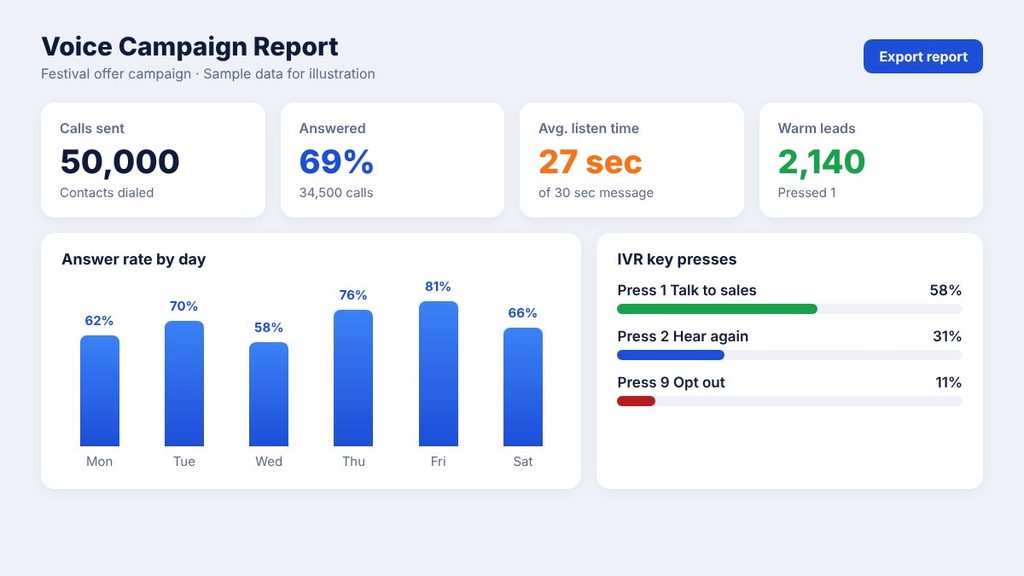
Track these numbers after every campaign:
| Metric | What it tells you | How to improve it |
|---|---|---|
| Answer rate | Share of calls picked up | Better timing, known caller ID, cleaner list |
| Average listen time | How long people stayed on | Stronger first 5 seconds, shorter script |
| Completion rate | Share who heard the full message | Cut extra words, put the offer early |
| Key-press (IVR) rate | Share who took action | Clearer call to action, fewer options |
| Transfer-to-agent rate | Warm leads sent to sales | Make “Press 1” benefits clear |
| Opt-out rate | Share who asked to stop | Better targeting, less frequent calls |
| Cost per result | Real value of the campaign | Shorter audio, better segments |
To track what happens after the call, add a trackable SMS smart link in your follow-up text. Then you can see who clicked after hearing the call.
Common Mistakes to Avoid
- Long messages. Most people decide in the first few seconds. Get to the point fast.
- Calling the wrong people. Old or bought lists waste money and annoy people.
- Calling too often. Too many calls lead to opt-outs and spam reports. Call fatigue is real; Truecaller’s CEO has said millions of calls from India’s 140 and 1600 series go unanswered every day (Outlook Business).
- Poor audio. Background noise, music that drowns the voice, or a fast speaker ruins the message.
- No call to action. Always tell people what to do next.
- No opt-out. This breaks rules in many places and hurts trust everywhere.
- No follow-up. A call with no SMS or WhatsApp follow-up leaves details behind.
How to Combine Voice, SMS and WhatsApp
The best results often come from using channels together. Here are three proven combinations.
Voice first, then SMS. Use this for urgent alerts and reminders. The call grabs attention. The SMS keeps the date, time and link.
SMS first, then voice for non-responders. Send a text to everyone. After a day, call only those who did not click or reply. This keeps costs down and lifts results.
Voice for reach, WhatsApp for conversation. Use a voice call to reach a wide audience. Invite interested people to press 1 to get details on WhatsApp. Then continue the chat there.
You can also let people come to you. A missed call number lets customers give a free missed call to register interest. Your system then calls or texts them back. Add bulk email marketing for customers who prefer detailed updates.
Real-World Use Cases by Industry
| Industry | How voice or IVR helps |
|---|---|
| Banking and finance | EMI and payment reminders, card activation, fraud alerts |
| Ecommerce | Cash-on-delivery order confirmation, failed delivery follow-up |
| Healthcare | Appointment reminders, vaccination drives, health camps |
| Education | Admission alerts, fee reminders, exam dates, parent notices |
| Real estate | Site-visit invites with press 1 to connect to an agent |
| Retail | Festival sales, store openings, loyalty rewards |
| Agriculture | Weather alerts, crop advice and scheme updates in local languages |
| Politics and government | Voter outreach, public awareness, emergency alerts |
| Utilities | Bill due reminders, outage alerts, meter reading updates |
Conclusion: Use Voice Where It Wins
Bulk voice call marketing is not old-fashioned. It is the right tool for specific jobs. Use it when your audience cannot read easily, has no smartphone or data, speaks a local language, or needs to hear a trusted voice. Use it for urgent messages and for quick IVR replies at scale.
Use SMS for codes, links and receipts. Use WhatsApp for rich media and real conversations with opted-in smartphone users. And combine them whenever you can.
Ready to try it? Explore our bulk voice call service or contact our team for a free campaign plan. For more ideas, browse our marketing guides.
Frequently Asked Questions
What is bulk voice call marketing?
Bulk voice call marketing is sending one pre-recorded voice message to many phone numbers at once. An automated system dials the numbers and plays your message when people answer. It is also called voice broadcasting or a voice blast.
What is the difference between a voice broadcast and an IVR call?
A voice broadcast is one-way. People only listen. An IVR call is two-way. Listeners press keys on their phone to respond, such as “Press 1 to talk to sales.”
Is voice call marketing better than SMS?
It depends on the goal. Voice calls work better for low-literacy audiences, local languages, urgent alerts and quick IVR replies. SMS works better for codes, links, receipts and short updates people can read later.
Is bulk voice call marketing better than WhatsApp?
Voice is better when your audience uses basic phones, has no internet, or cannot read easily. WhatsApp is better for opted-in smartphone users when you want to send images, videos, catalogs or chat with customers.
Is bulk voice call marketing legal?
Yes, in most countries, if you follow local rules. Get consent, respect do-not-call lists, identify your business and give an easy opt-out. Some countries also require special number series for promotional calls, like the 140 series in India.
How much does a bulk voice call cost?
Cost depends on your country, provider, call length and volume. Most providers charge per connected call, per pulse (often 15 or 30 seconds) or per minute. Keeping your message under one pulse lowers the cost.
How long should a bulk voice call message be?
Aim for 20 to 45 seconds. Say who you are in the first few seconds, share the main point, and end with one clear action. Shorter messages get more people to listen to the end.
Can I use my own voice for a voice call campaign?
Yes. You can record your own voice, hire a voice artist, or use text-to-speech. A real, familiar voice, such as a business owner or local leader, often builds more trust.
What is a good answer rate for bulk voice calls?
There is no single benchmark. It changes by country, list quality, caller ID and timing. Track your own answer rate across campaigns and work to improve it with cleaner lists, better timing and a recognizable number.
Can bulk voice calls connect people to a live agent?
Yes. With an IVR “press 1” option, interested listeners can be transferred straight to your sales or support team. This sends only warm leads to your agents.
Which industries use IVR marketing the most?
Banking, ecommerce, healthcare, education, real estate, retail, agriculture, utilities and political campaigns use IVR marketing widely. Any business that needs fast reach or quick confirmations can benefit.
Should I use voice calls, SMS and WhatsApp together?
Yes, combining them usually gives the best results. Use voice to grab attention, SMS to share links and codes, and WhatsApp for rich media and conversations.
Publishing checklist and sources
Publish with Article plus FAQPage schema, an author box, and the internal links above; this covers the E-E-A-T and AI-answer signals the brief asks for.
- Paste the article; keep the “Quick answer” paragraph directly under the H1 (featured snippet and AI overview target)
- Set SEO title, meta description, focus keyphrase and slug from the SEO pack (Yoast or Rank Math)
- Add an author box with a real name, role and years in telecom or messaging (E-E-A-T)
- Add one real campaign example or client result with numbers from your own data, if you have permission to share it
- Upload images as WebP under 100 KB with the file names and alt text listed above
- Add Article and FAQPage schema (Rank Math or Yoast FAQ block handles FAQPage automatically)
- Add a link back to this post from /voice-calls/, /bulk-sms/ and /whatsapp-marketing/
- Show “Last updated” date; recheck WhatsApp pricing and TRAI rules every quarter
- Submit the URL in Google Search Console after publishing
The article is written to stay original and specific, but no tool can guarantee a page passes every AI detector or reaches position 1; adding your own campaign data and author details is the strongest lever for both.